

Incompetent or Imperial? Rethinking Western Leadership in an Age of Decline
From NATO doctrine to Ursula von der Leyen, today’s transatlantic leaders appear incompetent, until we ask: competence for whom?

Prelude: The “incompetence” complaint
“Today’s Western leaders are incompetent.” The line has become an analyst’s reflex. We watch Kaja Kallas, the EU High Representative, as she breezily skates past the Soviet and Chinese roles in WWII, saying that it was "news" to her that China and Russia were among the victors who defeated Nazism, as if history were a prop. Annalena Baerbock’s glossy Instagram videos as UNGA’s fresh face feel like comedic stagecraft in search of statecraft. Donald Trump states, with full confidence, that Spain is in BRICS. And the much-touted “deal” between von der Leyen and Trump reads less like a European policy strategy than a pledge of subservience.
Author and analyst Jacques Baud captured the mood in an interview:
“Europe has engaged in a kind of moralistic, hegemonic type of behavior that, in fact, supports U.S. policy. Not even for the benefit of Europeans, but for the simple, the mere benefit of the U.S., which is extremely strange. And we have an example of that in the recent agreement, or so-called agreement, that we had between the U.S. and the European Union.”
Strange indeed. And the catalogue of facepalms could run on.
Yet look at the other side of the coin: Bailouts for capital flow without friction; privatization and welfare cuts accumulate across Europe in the name of “defense”. Alliance discipline holds as military interoperability with Washington deepens, and the pageantry of summits delivers its images. NATO war games multiply. Narrative control is tight: media and official spokespeople harmonize, and the showman still speaks directly to his slice of the electorate, facts notwithstanding.
Fools or geniuses? The question misfires. We are grading with the wrong scale.
Political scientist Harold Lasswell suggested asking, who gets what, when, how? In fast-moving crises and complex socio-political processes, the better question is: competence for what, and for whom—toward which goals? If the selectorate that matters sits in transatlantic policy and capital networks, then selection will reward those who serve that bloc (procurement brokers, sanctions architects, alliance disciplinarians, narrative managers) rather than exam-tested administrators with an adequate education for the role assigned to them, tasked with delivering public goods. Unfortunately, revolving doors and network vetting don’t produce local problem solvers. They produce specialists of imperial management.
That is why “incompetence” has two faces. From the standpoint of ordinary people—Normalsterbliche (mere mortals), as my father would say—services falter, costs rise, institutions and infrastructure grow brittle, and leaders look unfit for purpose. From the standpoint of the transatlantic bloc, many of those same leaders are performing: they hold coalitions together, channel budgets to where they’re wanted, stigmatize rivals, and keep the spectacle moving. Both readings can be true because they grade two different assignments.
Indeed, a 2022 study on the topic stated:
“with routine workers and skilled production workers perceiving themselves as much less well (politically) represented than upper middle-class professionals. Analysing changes over time, we show that class gaps were already large in the mid-1970s and increased further over the following decades.”
So, the work ahead is to identify the divergence and measure it. Competence is not a monolith, not a timeless civic virtue. Instead, it is a product of its time and space: selection mechanisms, a polity’s role in the world-system and surrounding entities’ material flows, and a legitimizing worldview that teaches elites, and the rest of us, what counts as “doing a good job.” When those three align around bloc maintenance rather than public welfare, we get what we see today: thick stagecraft, thin statecraft.
From here, the essay will do three things. First, map this competence function across time and space—keju China, Habsburg Spain/New Spain, Prussia, British India, the U.S., France, the PRC—to show how these different factors define what “good” looks like. Second, update sociologist Tilly’s concept of specialists of violence: today’s upper strata cultivate specialists of imperial management. Third, bring contemporary documents to the surface—the NATO Defense College’s “mass mobilization” doctrine, the Powell memo, The Crisis of Democracy, the TTIP leak, to show the selectorate speaking in its own voice.
Only then can we return to the complaint about incompetence and give it precision. Not a change of faces, but a change of who selects, how they measure, and what they reward.
Introduction: What’s the Competence Conundrum?
This is the competence conundrum in its starkest form: leaders who appear profoundly incompetent at serving their citizens somehow remain in power, advancing policies that contradict popular will. When John Helmer observed in his interview with Glenn Diesen that German leaders must "repress them, make them afraid, destroy their universities, destroy their press, destroy their publications, their bookshops, and make everyone in Germany afraid to open their mouth" to implement unpopular policies, he was revealing the operational logic of a system where elite competence is defined not by representation, but by the management of citizens as obstacles—and resources—for imperial objectives.
This (conceptual) article argues that what looks like Western elite “incompetence” is competence of a different kind: calibrated for maintaining transatlantic power structures rather than delivering public goods. In practice, two qualitatively different competence regimes operate inside Western institutions:
Administrative (Civil-Service) Competence – rooted in merit, exams, implementation, and feedback
Imperial-Network Competence – built on habitus, access, coalition loyalty, and narrative control
By examining historical patterns, contemporary examples, and elite doctrine (including the startling revelations in NATO Defense College's NDC Insight 05-2025), we'll demonstrate that competence is not a neutral technical capacity. It is contingent on several factors. Among them:
Selection mechanisms (exams vs. networks vs. pedigree)
World-system role (ccore, semi-periphery, or challenger status)
Material flows (the dynamics of resource flows at a given point in time)
Legitimizing worldview (the ideological frame that makes certain forms of rule appear legitimate)
Ultimately, this framework reveals that the pervasive sense of elite failure is a mirage. The real crisis is not one of incompetence, but of allegiance. By asking "competence for whom?", we can cut through the spectacle of individual blunders and identify the true power structures, the imperial selectorate, whose priorities are fundamentally disconnected from the needs of the citizenry.
I. The Competence Contingency: A Framework
To understand why Western elites appear simultaneously incompetent and unshakeable, we need a new framework. Competence is not an inherent quality but a political construct; a function of a system's goals and structure. This is especially true for power elites, the ruling strata tasked with managing a territorial entity’s complexity. The territorial growth of any society—expanding population, rising production, more intricate social relations—demands a specialized managerial class to administer distribution and maintain order (especially as polities disperse across space). Urban planning, state formation, and administrative history all grapple with the same questions: who gets selected to manage complexity, how they are selected, and what they are rewarded for delivering. Those administrators and coordinators need competence, but what counts as competence changes.
1.1 Redefining Competence: A Dynamic Construct
Competence cannot be reduced to a mere technical skill when we’re talking about apex roles. It is a dynamic concept, endogenous to a system's core structures and fundamentally contingent on time and place.
Place—a specific geographic and social space—determines the available resources, the identity of its inhabitants, and the historical trajectory that shapes its institutions. Each entity develops unique selection mechanisms, legitimizing worldviews, and distribution patterns based on these material and social conditions.
Time—historical moments and phases—defines the context: an era of technological revolution, shifting trade routes, natural catastrophe, or external coercion like war and invasion. These factors can reorder material flows, alter a polity’s position in the global hierarchy, and redefine what both elites and publics accept as legitimate rule.
This spatio-temporal contingency means competence cannot be universalized. What made a Ming Dynasty administrator competent would have been irrelevant in Habsburg Spain; the skills of a British East India Company agent would have failed a Prussian bureaucrat. Competence regimes are often not designed or implemented around abstract ideals of good governance, but to serve particular interests at particular historical moments.
1.2 The Three Pillars of the Competence Contingency Framework
The spatio-temporal pressures above work through three core factors. Together, they define how a system defines and rewards competence.
Selection Mechanism: Who Defines Competence?
This pillar encompasses both the selectorate (who chooses the elites) and the process of selection. Is the selectorate the citizenry, party committees, allied governments, corporate & financial peers? Are candidates chosen via competitive exams and transparent procedures, or through lineage, network trust, habitus, money, ideological conformity, or some blend?
The mechanism acts as a filter:
Citizen-based selection (exams, transparent processes, codified procedures) tends to produce administrators focused on public goods delivery. Exam systems filter for rule-following, domain mastery, and service ethos, creating a professionalized administration (sometimes called Weberian bureaucracy).
Elite-network selection (revolving doors, dynastic capital, ideological conformity) produces specialists in bloc maintenance. This filters for reliability to the selecting coalition. As Bourdieu's concept of "state nobility" suggests, elite reproduction often privileges certain forms of capital, cultural, social, and economic, over merit.
The selection mechanism is the first filter and the factory: it manufactures elites suited to its own actual and perceived environment.
World-System Role & Material Flows: What Competence Must Achieve
Where does the entity sit in the global hierarchy, and what flows sustain it—taxes, rents, seigniorage, energy, logistics, data, technology? Is it core, semi-periphery, periphery, or a challenger? Wallerstein's world-systems theory provides the analytical lens:
Core powers (e.g., Habsburg Spain, contemporary U.S.) develop competence frameworks optimized for extraction and hegemonic alliance management.
Semi-peripheral risers (e.g., Prussia, modern China) focus on administrative capacity-building and infrastructural development.
Peripheral territories (e.g., colonial Mexico) experience competence defined by loyalty and brokerage to external powers, moving resources outward to the core.
Material flows—taxes, rents, energy, data—determine the stakes. Tax-dependent systems reward administrative efficiency and institutional continuity, while rent-based systems favor loyalty and external extraction skills. Surrounding dynamics matter too: rising neighbors, collapsing neighbors, shifting energy and data routes—all can change flows and thereby change what competence must do.
Concrete yardsticks change with position: A Spanish viceroy in New Spain was competent (in the eyes of the selectorate) if silver shipments reached Madrid; a modern finance minister is competent if bond markets stay calm and capital flows remain stable.
Legitimizing Worldview: How Competence Is Sold
No system sustains itself through coercion alone. It requires an ideology that justifies its social order to both the governed and the governors. This worldview makes a specific type of competence appear natural and legitimate:
Confucian meritocracy framed competence as moral cultivation through classical learning. The "civilizing mission" justified British imperial rule through the rhetoric of bringing order to "backward" peoples. At the same time, liberal internationalism presents Western intervention as spreading democracy rather than securing capital flows.
These worldviews license practice to the selectorate and sell it to the governed, scripting the public language of “merit” and “expertise” while often masking the system's true function. These frameworks are anchored to material interests and institutional routines.
In crude terms: Competence = f(Selection Mechanism, World-System Role & Material Flows, Legitimizing Worldview). Change the inputs and you change who rises, which skills are cultivated, and whether a system tends to produce administrators or specialists of imperial management.
1.3 Procedural vs. Substantive Democracy: The Performance Legitimacy Divide
Professor Zhang Weiwei's distinction between procedural and substantive democracy helps explain why contemporary governance can feel disconnected from citizen needs:
Procedural democracy ("democracy in form") focuses on mechanisms: elections, multi-party systems, voting; legitimacy rooted in procedure.
Substantive democracy ("democracy in substance") measures whether governance delivers tangible improvements in living standards, equity, and welfare; legitimacy rooted in outcomes.
The modern transatlantic model prioritizes procedure while neglecting substance. This is where Huntington's concept of performance legitimacy becomes relevant: legitimacy can derive from effective delivery even amid procedural shortcomings, while procedural legitimacy only endures as long as substantive decline remains tolerable.
In much of the transatlantic sphere, elite competence increasingly serves the procedural register while eroding the substantive one. Leaders excel at alliance cohesion, narrative management, and channeling resources to transatlantic capital networks—the skills their selectorates reward. Yet these same skills produce crumbling infrastructure, declining living standards, and militarized societies that citizens experience as profound incompetence. Both readings are coherent because they judge against different goal functions.
This is not accidental, nor a personality problem, but predictable. It follows from a competence regime where selection flows through imperial networks rather than citizen-based institutions. Understanding this shift from public service to imperial management explains why Western policies succeed spectacularly for elites while failing catastrophically for citizens: a legitimacy gap opens and widens.
Where the Variables Recombine
Section II turns to comparative snapshots: keju China; Habsburg Spain and New Spain; Prussia; British India; the United States from spoils to Pendleton to the revolving door; France’s grandes écoles; and the PRC’s reform-era cadre system. In each case, we’ll track the selectorate, flows, and world-position, legitimizing worldview, and the resulting definition of competence. The aim is to show the pattern and why today’s Western split between administrative capacity at the base and bloc maintenance at the apex follows directly from the function above.
II. Case studies in competence regimes
What follows are ideal-type snapshots. They don’t deny internal variation—local vs. national, urban vs. rural—but they do surface the dominant tendencies in each regime: who selects, what flows matter, which worldview legitimates rule, and how “competence” gets defined.
Imperial China: the keju examination state
Selection mechanism: Rigorous Confucian exams in classical texts and statecraft filtered officials for moral philosophy and administrative craft.
World-system role: Tributary hegemon; flows of rice and silver taxes underwrote stability.
Legitimizing worldview: Mandate of Heaven; competence equated with moral harmony delivered by scholar-officials.
Resulting competence: Classical-moral literacy plus administrative capacity; high implementation power, yet vulnerable to rote classicism.
Elite power function: Filter literati loyal to imperial cosmology and legitimizing authority through Confucian ethics; “competence” left land inequality unaffected.
Habsburg Spain & colonial New Spain: venalidad de oficios
Selection mechanism: Offices sold to the highest bidder.
World-system role: Extractive core; silver from Potosí and New Spain flowed to Madrid.
Legitimizing worldview. Divine Right Monarchy; competence meant loyalty to Crown and Catholic orthodoxy.
Resulting competence. Maximize silver extraction; governance tilted toward brokerage and rent.
Elite power function. Officeholders recouped costs through forced labor and tribute; “competence” required ignoring indigenous suffering.
Prussia (18th–19th c.): cameralist bureaucracy
Selection mechanism: State examinations and legal training professionalized the cadre of state officials who formed the backbone of Prussian administration.
World-system role: Semi-peripheral riser hardening into a militarized core; grain and tax revenues fed armies.
Legitimizing worldview: Cameralist rationality: competence defined as legal-administrative mastery of taxation, finance, and logistics, all directed toward sustaining a gradually militarized state.
Resulting competence: Efficient resource extraction for war over peasant welfare.
Elite power function: Bureaucrats were “competent” when they financed militarization, not when they alleviated hardship.
British India: the Indian Civil Service
Selection mechanism: Oxford- and Cambridge-centric exams in classics (not Indian laws & languages).
World-system role: Colonial periphery; cotton and opium shipped to London—an extraction hub.
Legitimizing worldview: “White Man’s Burden”; competence = “civilizing” through order.
Resulting competence: Manage extraction with minimal rebellion; census and survey over Indian population representation; famines on a catastrophic scale under “efficient” rule.
Elite power function: The ICS’s scholars and bureaucrats were valued for their cultural polish and demeanor rather than any expertise in Indian languages, laws, or needs.
United States: the revolving door
Selection mechanism: A hybrid system: In the 19th century, most federal jobs were distributed through the spoils system: political loyalty and party service were the main currencies. After the 1883 Pendleton Act, lower- and mid-level posts shifted to meritocratic exams and rules, creating a professional career civil service. But at the apex, the spoils logic continues: Cabinet secretaries, regulators, and senior officials are still chosen through politicized and networked channels, shuttling between ministries, law firms, finance, and consultancies (aka revolving doors).
World-system role: Financial hegemon; dollar dominance, data capitalism, and sanctions leverage shape flows.
Legitimizing worldview: Democratic rhetoric fused with liberal internationalism; competence = “serving the people” while serving capital’s stability.
Resulting competence: Administrative islands below; imperial-network competence at the top.
Elite power function: The revolving door certifies competence as access to capital and coalition reliability, not public service delivery.
France: the Grandes Écoles and a narrow selectorate
Selection mechanism: After 1945, France built a prestige conveyor belt for its senior state elite through the grandes écoles: ENA, École Polytechnique, HEC. ENA (École Nationale d’Administration), founded to professionalize the upper bureaucracy, soon became the finishing school of power; even after its 2021 replacement by the INSP, the pipeline endures. Formally, this is exam-based merit, but not sociologically speaking.
World-system role: Semi-core EU power; EU budgeting, arms exports, and colonial legacies shape flows.
Legitimizing worldview: Republican universalism: claims to treat all equally under a single law. Policy is presented through technocratic neutrality: decisions are framed as the outcome of expertise and necessity, not class interest or ideology.
Resulting competence: High policy capacity within a narrow selectorate: Bourdieu’s state nobility in action (tight alumni networks and shared habitus); preserving French capital’s position even as executives bypass parliament on contested reforms.
Elite power function: Filters for loyalty to finance-state priorities over popular demands.
PRC (reform era →): targets, cadres, recalibration
Selection mechanism: Since the reform era of 1978, China’s competence regime has fused exams with cadre evaluations. Entry into the bureaucracy involves standardized tests, but advancement depends on meeting performance targets: GDP growth, poverty reduction, stability, and campaign execution. A crucial feature is the use of anti-corruption campaigns.
World-system role: Rising challenger through manufacturing dominance, data control, and technological sovereignty demand cadres able to deliver rapid development without fracturing stability.
Legitimizing worldview: “Socialism with Chinese characteristics”: frames market reforms and modernization as consistent with socialist principles, tailored to China’s history and conditions. It authorizes the blend of Party control with pragmatic adaptation.
Resulting competence: oriented toward target delivery and political reliability. Hundreds of millions were lifted from poverty.
Elite power function: Anti-corruption drives recalibrate loyalty while channeling material flows toward domestic stability and long-term systemic ascent.
2.1 What these vignettes show
Read through the competence-contingency lens, and the pattern is consistent. Selectorates and material flows set the job description; worldview binds it. Where the selectorate is broad and revenues depend on taxation—as in Prussia’s state-building or the PRC’s reform-era targets—competence gravitates toward administrative delivery: budgets that balance, infrastructure that works, bureaucracies that learn. Where the selectorate is an imperial/elite network and revenues lean on rents or extraction—as in Spain/New Spain or the contemporary US/EU apex—competence tilts toward imperial-network skills: access and loyalty, coalition discipline, sanctions construction, procurement channels that never run dry. Shocks reorder the mix: war and fiscal stress can force meritocratic bursts. Worldview—Confucian moral order, Catholic monarchy, rational-legal authority, the civilizing mission, liberal-internationalist teleology, socialism—legitimates these arrangements and teaches both public and elite how “competence” should look.
From here, the thesis follows: competence serves the system that selects it. Colonial cores (Habsburg Spain, Britain) graded competence by how efficiently wealth moved from periphery to center. Today’s Western apex grades competence by market and alliance stability (or vassal obedience), often by managing citizens as a mass in the service of capital flows. The outlier clarifies the rule: the PRC today ties legitimacy to domestic performance because its world-system role demands internal cohesion to survive the challenges of a crumbling hegemon; selection and metrics follow from that position.
2.2 What actually defines competence (operational lenses inside the framework)
To make this diagnostic usable, three within-framework lenses do most of the practical work:
Primary project of the state (maps onto flows and worldview):
War-making polities (Prussia) valorize logistical mastery of taxation and violence; welfare states (post-WWII Europe) prize the technical administration of social programs, health, infrastructure; neoliberal/hegemonic states (contemporary US/EU) rate highest the management of global capital, alliance maintenance, and elite reproduction—the niche where specialists of imperial management thrive.Balance of class power (shapes the selectorate):
Landed aristocracies elevate lineage and honor; financial bourgeoisies elevate network capital and managerial credentials. Each redefines who gets to choose and what counts as skill.Geopolitical scale and position (situates flows and selectorate):
Empires select imperial managers; neutrals select legal-diplomatic competence. Core, semi-periphery, and periphery roles reweight the mix of administrative vs. imperial skills.
These lenses further operationalize the presented framework. They determine who is hired (by what criteria), who is promoted (according to which results), and what policy styles become dominant. In other words, they show how abstract structures of power materialize in the everyday workings of elite careers and statecraft.
With this in mind, we can now turn to our own time. Contemporary neoliberal and hegemonic states, above all in the transatlantic bloc, exhibit their own hybrid form. At the base, islands of administrative merit still exist: municipal administrations, courts, and statistical offices. But at the apex, competence is no longer measured in public service delivery. It is defined by the ability to manage alliances, choreograph sanctions, channel procurement flows, and control narratives. In short, by the rise of what might be called specialists of imperial management.
III. The Modern Western Hybrid: Administrative Base, Imperial Apex
The competence contingency reveals itself with brutal clarity in today’s West. At the base, administrative institutions remain: municipal governments that can still deliver services, courts and statistical offices that function with some professionalism, technical agencies where Weberian logics of rules and exams still linger. Yet this base is increasingly overshadowed by an apex defined not by citizen-facing administration but by bloc-facing management. In other words, competence is measured by success in preserving and extending the transatlantic order.
The apex, consisting of foreign ministries, heads of finance departments, central banks, and supranational bodies like the EU Commission, functions within its own logic. Its selection mechanism is the revolving door. This is the key institution that socializes elites into the priorities of the transatlantic bloc.
3.1 The TTIP and US-EU “Deal”: A Case Example
The now-infamous leak of Transatlantic Trade and Investment Partnership (TTIP) documents in 2016 stands as a revealing case in the politics of regulatory capture. EU and US negotiators exhibited a high degree of competence, if measured by their ability to advance business interests. Among the most telling details are the proposed “notice-and-comment” procedures, which reveal US negotiators' push for mechanisms enabling American businesses to directly co-draft EU regulation, a process reminiscent of US domestic rule-making. This system, spelled out in the Regulatory Cooperation chapter, would have given private industry unprecedented influence over official European policy-making, effectively institutionalizing corporate regulatory capture.
Yet, when measured against democratic sovereignty or public health standards, negotiators fell catastrophically short. The leaked texts contained stark omissions: longstanding environmental protections, such as the General Exceptions found in the WTO’s GATT agreement, were absent; the EU’s precautionary principle was replaced by US-style risk management approaches, favoring market access over preventive regulation. The result is a transfer of power from citizens and legislators to multinational business interests.
In 2025, a “deal” struck between US President Trump and European Commission President Ursula von der Leyen echoes these dangers, perhaps surpassing them. According to the watchdog group LobbyControl, the new agreement is shadowed by the same regulatory weaknesses. Washington’s negotiators secured broad exemptions from EU rules in areas like food safety and digital oversight, opening the door for non-compliant products to enter the EU market. Aside from the headline 15% tariffs on most EU exports to the US, ordinary Europeans saw the deal as a failure of leadership. Yet, for von der Leyen’s selectorate, the circle of high-level politicians, corporate lobbies, and Atlantic institutions, she embodied precisely the form of competence they prize: disciplined alignment with US policy objectives and the reliable advancement of “alliance” goals.
3.2 The Archetype: Ursula von der Leyen
Von der Leyen herself is an archetype of the imperial apex: not a technocratic administrator built in examination halls, but a product of centuries-old, interwoven aristocratic and merchant lineages. Born in Brussels as Ursula Gertrud Albrecht, her father, Ernst Albrecht, was an early official in the European Community and later Minister-President of Lower Saxony, springing from Hanover’s bourgeois civil-service society. Her Hanseatic ancestors amassed fortunes in cotton commerce. At the same time, family connections reach into Russian imperial enterprise through the Albrecht–von Knoop lineage, and across the Atlantic into Charleston’s Ladson dynasty of slaveholding planters. During her brief stay in London in 1978, she adopted the alias “Rose Ladson,” invoking her American ancestral ties.
Marriage further cemented her position. By marrying Heiko von der Leyen, she linked into the Krefeld silk-merchant nobility, an ennobled family whose estates and social standing span generations. In von der Leyen, a classic European-American elite continuum converges.
Her professional path is medical, not military or legal. Von der Leyen earned an MD and MPH before entering politics in midlife, advancing rapidly through family and labor ministries. She assumed the Defense Ministry without any military background, a tenure dogged by contracting scandals. Her leap to the European Commission presidency, outside the formal candidacy process and with scant EU institutional experience, exemplifies how top selection in today’s European Union pivots on network consent far more than on formal, exam-tested administrative merit.
For ordinary citizens, this often reads as privilege or failed governance or both. For the true selectorate, it represents the highest form of competence: a leader who reflexively serves the coalition first, preserving its cohesion and hegemony, whatever the cost and by whatever means.
She is, however, just one among many in today’s seemingly “incompetent” Western ruling strata. So let’s turn to the cast itself: the specialists of imperial management.
3.3 The Specialists of Imperial Management: Updating Tilly Through Lenin
Historian and sociologist Charles Tilly offers a valuable insight: the builders of modern states were not warriors but organizational entrepreneurs who employed specialists of violence. Medieval rulers consolidated territorial control not by swinging swords themselves, but by coordinating mercenaries, armies, and militias. To grasp today's global power structure, we must marry this insight to Vladimir Lenin's analysis of imperialism. Where Tilly focused on how state-makers emerged as organizers of violence specialists to consolidate territorial control, Lenin identified how capitalism's monopoly stage produces organizers of global economic management who coordinate the world system around finance capital's needs. (Note: Lenin's usage refers to the merger of banking and industrial capital into a dominant force seeking global markets.)
This synthesis reveals the custodians of modern hegemony as "specialists of imperial management": a transnational elite who, like Tilly's state-makers, function as organizational coordinators rather than direct practitioners with specialized knowledge. They orchestrate networks of financial experts, military contractors, and media professionals while remaining removed from the actual implementation and without needing to master any of these domains directly. This is the current Western Hybrid model of competence with its Imperial Apex and Administrative Base structure.
The Organizational Logic of Imperial Management
Just as Tilly showed European rulers gradually absorbing armies and navies directly into the state's administrative structure while remaining organizational coordinators, today's imperial managers have absorbed global networks of specialists while maintaining their role as orchestrators of different types:
Extraction Coordinators organize, among other tasks, the concentration of production into monopolies. These figures design sanctions regimes and steer procurement budgets without directly implementing policy details. They employ armies of trade specialists, sanctions lawyers, and procurement officers while focusing on the strategic coordination that serves monopoly capital's global expansion.
Narrative Managers legitimize the unjust practices of finance capital. Rather than crafting messaging themselves, they coordinate networks of media specialists, think tank fellows, and communications professionals. Additionally, they might carry these narratives and entertainingly publicize them.
Alliance Disciplinarians coordinate the export of capital rather than commodities. They also orchestrate unity displays by directing diplomatic corps, intelligence networks, and economic pressure specialists. They try to maintain the division between creditor states and debtor states through organized specialist networks.
Crisis Improvisers manage the contradictions in transatlantic monopolist associations. They coordinate spectacular responses, e.g., emergency summits, by orchestrating teams of crisis communications specialists, diplomatic troubleshooters, and media strategists.
Upward Managers organize the protection of the complete territorial division among great powers. They coordinate networks of legal specialists, public relations firms, and institutional loyalists to shield principals from accountability. Thus, they try to ensure system stability.
The Logic of Separation
This structure embodies the Western Hybrid model's deliberate separation between Imperial Apex and Administrative Base. Imperial managers occupy apex positions, coordinating global networks and setting strategic direction, while remaining intentionally removed from technical implementation. As Lenin observed, finance capital separates ownership from production, creating a class that "lives entirely on income obtained from money capital" while being "completely removed from productive activity".
Thus, this pattern produces bureaucrats and other functional elites who lack the technical expertise or domain knowledge of the fields they are tasked to lead.
However, the starkness of this competence regime is a relatively recent phenomenon; the seeds for it were sown a century ago.
3.4 The 1936 Blueprint: Rejecting the Exam, Embracing the Network
This shift from administrative competence to imperial coordination was a gradual choice against a different model of competence; a choice that was already being defended in elite academic circles nearly a century ago, revealing the ideological roots of today's Western Hybrid system.
A 1936 review of Harold Lasswell's seminal work, Politics: Who Gets What, When, How, in the American Political Science Review captures this ideological stance with startling clarity. The reviewer, William Seal Carpenter, a political scientist of Princeton University, mounted a fierce defense against turning universities into training grounds for public service, dismissing such efforts as "training for the public service" conducted by "noisy fellows with brief cases in hand" who sought to "draw the cloak of political science about that which still remains the business of technicians".
Indeed, if specialized training were needed, "the government will provide the necessary vocational training for its employees".
The Blueprints
Read today, this review reveals a systematic rejection of building examination-based professional classes for state leadership. Carpenter's stance was a reflection of a practice that would ensure that elite selection would remain the domain of network socialization rather than technical examination. Ultimately, this 1930s preference for government-provided on-the-job training represents the primordial ancestor of today's revolving door: learn the craft in the corridors of power and be selected by the network you already inhabit.
This split, however, was not an isolated academic opinion. It became an unspoken staple of transatlantic elite strategy that leaned more and more in a particular direction, later articulated in different documents, tackling different aspects:
The Powell Memorandum (1971), for instance, was a confidential call to arms for corporate America. Penned by future Supreme Court Justice Lewis Powell, it urged corporate America to organize across think tanks, law firms, and media to reshape politics, media, and academia. In this instance, competence for business leaders was recast as the ability to protect the capitalist system. It provided the blueprint for the network of think tanks (e.g., the Heritage Foundation, Cato Institute) and legal advocacy groups (the Federalist Society) that would become central to reshaping the American political landscape.
As the memorandum stated:
"The foregoing references illustrate the broad, shotgun attack on the system itself. There are countless examples of rifle shots which undermine confidence and confuse the public."
In other words, for Powell and the corporate elite he represented (part of the selectorate), the public (and electorate) was a different entity, but powerful enough that it needed to be educated and stopped in its tracks.
Then came The Crisis of Democracy (1975), penned by the Trilateral Commission, a non-governmental international organization founded in 1973 by American banker David Rockefeller, along with other prominent figures like Zbigniew Brzezinski. The authors Michel Crozier, Samuel Huntington, and Joji Watanuki framed the 1960s and 1970s "democratic surge" as creating ungovernable societies. They argued that
"the vitality of democracy in the United States in the 1960s produced a substantial increase in governmental activity and a substantial decrease in governmental authority".
The cure the report implied, which involves participation to restore elite authority, clarifies where competence is to be judged: not by popular responsiveness, but by the system’s stability on elite terms. Again, the selectorate viewed public engagement itself as a threat to effective governance.
Taken together, these texts point to a conscious split: the selectorate (power elites) sets the standard (apex-administrative divide) and selects accordingly; the electorate (voting masses) is managed within that standard.
From Historical Blueprint to Contemporary Reality
We can now examine how this logic operates in contemporary strategic thinking. In our current rapidly shifting global dynamics, where American hegemony faces rising multipolarity, these blueprints have evolved from tactical responses to systemic organizing principles.
The question now is not whether elites will coordinate against democratic pressure, but how openly they articulate this coordination when facing strategic competitors who operate on different organizational principles entirely.
IV The NATO Document: The Selectorate Speaks Plainly
The full implications of this competence regime come into sharp focus when we examine the European Union’s rapid, active pivot from a welfare state model to one of mass mobilization for military aims. This strategic shift is visibly reflected in a changing framework of what is valued and rewarded within its institutions:
This remilitarization is the project of a transatlantic power elite desperately clinging to hegemony by any means available. The tone was set in Germany when the new Wehrdienstgesetz was rolled out at the Bendlerblock, where Stauffenberg was executed. Standing beside Chancellor Scholz, Defense Minister Pistorius, and Vice-Chancellor Klingbeil was General Alexus Grynkewich, commander of U.S. European Command, NATO’s top commander on German soil, smiling for the cameras at the announcement of a reinstated German draft. The image was a perfect allegory for the diminished sovereignty and imperial management that defines the current competence framework.
This context is essential for understanding a remarkable document published by the NATO Defense College in July 2025: Not Withstanding? An Upbeat Perspective on Societies’ Will to Fight. The paper is a candid glimpse into the mindset of the selectorate. Its central thesis is revealing:
“Mass mobilisation succeeds when the military adapts to society, not just the other way around.”
But the document's true significance lies in its intended audience, policy elites, explicitly stated as:
"Since you, the reader, likely help shape that policy, it pays to know your own bias – and to learn to trust."
Throughout, societies are treated not as polities of citizens but as a resource to be managed, a “mass” to be shaped and mobilized. The author laments that broad surveys are insufficient to gauge the nuances of public will, posing the questions that truly concern the alliance:
“Would you fight for your country if it prioritised victory at any cost?
Would you fight if you had personal ties to the adversary or believed NATO had acted belligerently?”
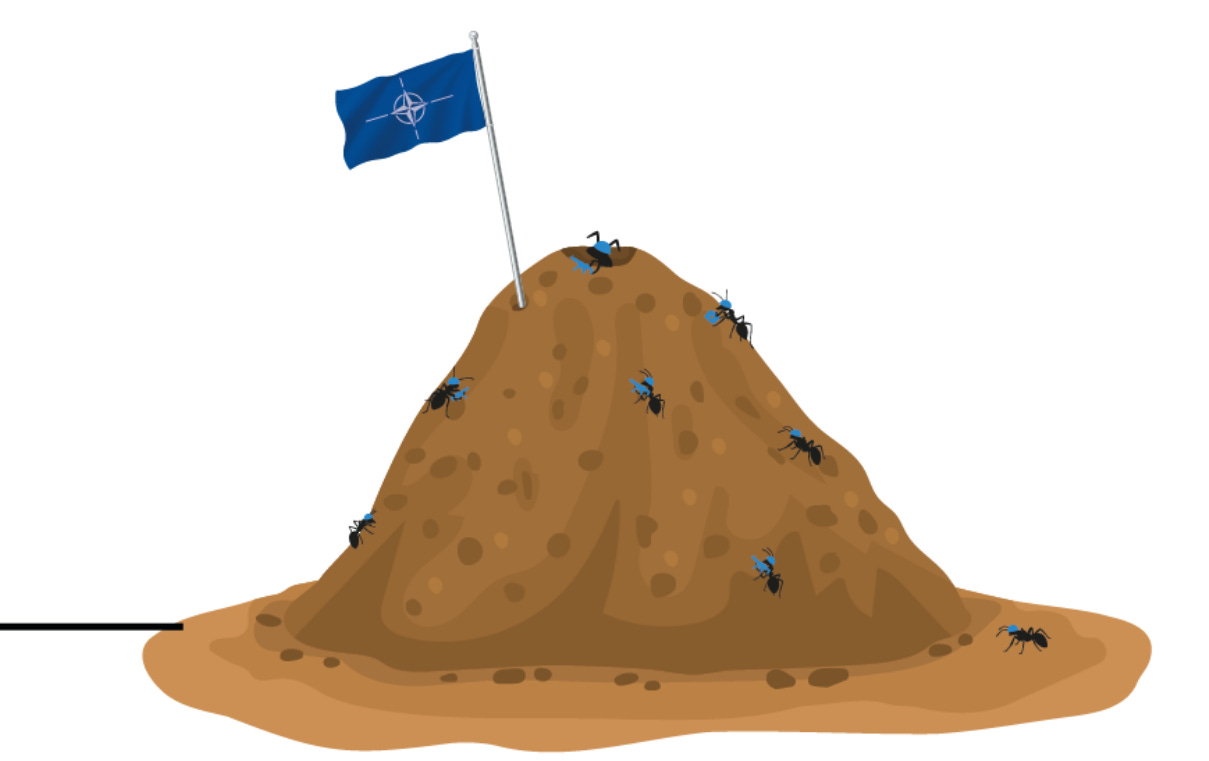
The document’s analysis confirms the crisis of performance legitimacy at the heart of the Western state, which won’t carry a war economy. It refers to citizens as “mass society” and admits that “few fight out of duty alone – and even fewer to preserve an unsatisfactory status quo.” Yet it attributes this not to a failure of elite governance:
“The real challenge of mobilisation is not demanding loyalty but inspiring belief in a future worth fighting for. Yet elites have often underestimated society's will to fight, precisely because the public lacks their sense of duty.
The problem, in this view, is not that the status quo is unsatisfactory, but that the masses fail to appreciate the elite’s dutiful stewardship of it. And, notice the language: "mass society" lacks "duty" while "elites" possess it. The assumption that ordinary people would suddenly believe they could rebuild their country better after a war reveals more about this power elite’s worldview than historical reality.
In essence, this statement also flips the burden: if people won’t fight for the status quo, the task becomes manufacturing a future worth dying for.
Perhaps most revealing is the prescription offered. The paper identifies three habits of statecraft for dealing with uncertainty: strategizing, planning, and “the use of imagination to influence the future.” This third habit, it claims, has been “missing in action since the end of the Cold War.” In the bland language of bureaucracy, this is a call for a more potent and manipulative narrative management: the competence of crafting a compelling story to mobilize the “mass,” irrespective of material realities.
Even the civilization-decline riff is framed as a failure of elite confidence, not public deprivation:
“If Luttwak’s historical cases teach anything, it is that elite fatalism can be more damaging than external threats. Civilisations have collapsed… because their ruling classes lost faith in their own societies. Rome’s elites prioritised self-preservation over public service; France’s aristocracy, convinced of inevitable decline, rejected even viable reforms; the Mughal and Ming rulers overlooked resilient local forces…”
So, collapse is explained as an elite mood disorder. The public appears only as “mass,” a reservoir to be tapped if elites recover their resolve and deploy sufficient “imagination.” What’s more, the problem isn't that elites "lose faith in their own societies"; it's that their definition of "society" excludes the very citizens whose welfare should be the state's purpose.
This NATO paper is an unconscious but perfect articulation of the imperial-competence regime. Competence in this case, as defined by the selectorate, is the ability to mobilize populations for alliance aims.
When competence diverges from the masses: repression fills the gap
As analyst John Helmer has argued, the absence of a significant anti-war movement in the U.S., Germany, or England is not a sign of consent but a result of systematic suppression:
"The only way to make this acceptable to the German people is to repress them, make them afraid, destroy their universities, destroy their press, destroy their publications, their bookshops, and make everyone in Germany afraid to open their mouth."
This is the logical endpoint of our competence divergence theory. The wider the gap grows between what elites value and what citizens need, the thicker the layer of repression, or the more aggressive the narrative management, required to maintain stability. The NATO document reads like a manual for mobilizing society, despite itself. It is the proof that for the transatlantic selectorate, a competent leader is not one who serves the public, but one who can manage it.
V Toward a Rebalancing of Competence Regimes
The preceding analysis reveals a fundamental divergence in how political systems within specific territorial entities derive their legitimacy and, by extension, how they define competence. Earlier, we touched on Prof. Zhang Weiwei’s distinction between procedural and substantive democracy. It is worth recalling briefly here:
The current Western path has rested legitimacy on procedure: elections, institutional rituals, and multi-party competition. But outcomes have deteriorated as housing, wages, public services, and life expectancy decline even as ballots are (supposedly) counted.
An alternative path measures legitimacy by substantive outcomes: whether governance delivers equity, stability, and tangible improvements in daily life, living standards, and infrastructural development, with procedural forms adapting to serve those outcomes.
Recognizing this divergence necessitates a paradigm shift from the “democracy versus autocracy” framework to a more substantive “good governance versus bad governance” analysis. As Prof. Zhang puts it, “a system is only truly democratic if it delivers results for its people.” This does not erase the need for procedure, but it reverses the logic: forms must serve outcomes, not the other way around.
The current Chinese model of a competence regime, for all its own complexities and shortcomings, exemplifies such a potential alternative. Its exam- and party-based system is engineered for a specific world-system role: that of an ascending core power whose primary goal is domestic stability and development. Here, competence is evaluated relentlessly against metrics like poverty reduction (800 million lifted out of it) and useful infrastructure: a form of performance legitimacy. In other words, legitimacy flows from what is built and delivered.
5.1 Why Western Elites Reject the Chinese Model
The West, by contrast, continues to train and promote elites whose competence is measured by their capacity to maintain alliances, regulate capital flows, and stage-manage crises, while increasingly neglecting the delivery of tangible improvements in citizens' lives (and possibly even worsening quality of life). This creates what Samuel Huntington termed a "performance legitimacy" deficit.
The Western elites are rejecting an exam-based competence model for all levels of their administrative and coordinating spheres because it threatens elite power and their role in the global and national order. Furthermore, the Western hybrid cannot adopt that model because its selectorate is different. Its apex elites are chosen by networks of capital, party bosses, and transatlantic institutions (or, in other words, by the same apex elites).
Today's transatlantic capital needs a ruling class that understands markets, and who doesn’t need to read books of classical literature or ethics. Such a "democracy" mythologizes elections as merit filters while ignoring the money and media influence that shape them for the public or working masses. In the West's current world-system role, competence means network access to Davos and Wall Street, and anything that aids them in their perception to keep their global hegemony. These different competence systems are incompatible because their ultimate goals and purposes are opposed.
This is not to present China's system as flawless; every competence framework faces challenges within its specific context, but to highlight a fundamental divergence in how legitimacy is constructed. Ultimately, the critical question isn't which system is "better" in abstract terms, but whose interests competence ultimately serves.
5.2 What Shifts the Equilibrium?
As the historical vignette has shown us, competence regimes are not static. They are dynamic, change, and bend under pressure:
War mobilization and fiscal stress have often forced meritocratic turns: standardized exams, tighter audits, and higher demands for administrative delivery. Yet, the prospect of a war has its own serious challenges, it can act as a critical juncture and can go in either direction.
Administrative innovations, from the statistical revolutions of the 19th century to today’s digital registers, can lower monitoring costs and tilt systems toward performance. Still, the goals of a competence regime would need to be re-adjusted for public service and delivery.
World-system demotions, loss of imperial rents, diminished access to capital flows, can reduce resources for elite reproduction and force governments to re-invest in public goods. Even though, admittedly, this is a very slow process.
Social upheaval (of those excluded from the selectorate) that is organized and directed toward changing the competence regime, the elite socialization pathways, and so on.
These are some of the levers that have historically shifted what “competence” means.
5.3 Reclaiming Competence: A Path Forward
Acknowledging this structural conflict is the first step. The solution is not to find “better” people within the same broken machine but to change the machinery itself. This requires targeting and changing the selectorates, incentives, and mechanisms of selection. While some network competence may always be necessary for a state’s external relations, the goal must be a radical rebalancing toward public-goods capacity.
Concrete institutional reforms could include:
Rebuilding Examined Corps: Establish transparent, exam-based career ladders for key tracks in foreign service, procurement, digital/AI regulation, and other areas, with promotion tied to measurable outcomes that serve the public good.
Erecting Firewalls: Mandate stringent and long cooling-off periods between ministries, regulators, contractors, and consultancies to sever the revolving door’s circulatory system.
Enforcing Transparency: Require full funding disclosure for think tanks and policy media, tagging all reports with sponsor affiliations.
Creating Independent Audit Bodies: An independent Strategy & Evaluation Corps, separate from communications units, to audit official strategies against their real-world outcomes.
Mapping Elite Concentration: Systematically disclose the concentration of elite-school and dynastic networks in top appointments, treating extreme density as a critical governance risk.
University Funding: Either stop the practice of so-called third-party funding or increase governmental financing, and reduce third-party funding while maintaining transparency as open as possible.
And so on, for all areas that pertain to the ruling strata or functional elites of a country.
Alongside these, democratic innovations, citizen assemblies for policy design, metrics that measure life expectancy, decline in poverty rates, housing, and ecological health instead of GDP alone, would help shift competence regimes back toward serving the governed.
Before almost closing this essay, I want to provide you, dear reader, with some questions that can help you gauge imperial-network competence in real time:
Who actually benefits from this policy?
What would happen to this leader if they defied transatlantic networks?
Is this "incompetence" concentrated in areas that serve citizens?
A Caveat
This essay has been conceptual, even schematic. Competence regimes and the historical vignettes, as sketched here, are ideal types. Every society carries contradictions between center and periphery, apex and base, procedure and outcome. Empirical tests remain necessary. Indicators could include the share of appointments filled through competitive exams, the density of revolving-door rotations, continuity of service quality across partisan cycles, the tracing of transatlantic biographies (e.g., expertise vs. position filled), the existence of long-term urban and regional planning strategies, or public satisfaction surveys.
The hypothesis is clear: we should expect a strong negative correlation at the apex of power. As the density of revolving-door appointments and imperial tasks increases, administrative performance indicators will deteriorate. This theory can be tested through cross-national comparison, analysis of crisis periods, and studies on the effects of “dynastic capital” on public policy outcomes.
The struggle to redefine competence is ultimately a struggle over power. It is about whether our societies will be managed as a “mass” to be mobilized for external goals or governed as a citizenry to be served. Reclaiming competence means building institutions that once again select for the latter.
Closing Notes: The Competence of Collapse
The feeling of gaslighting is real. We are told to trust leaders who preside over crumbling infrastructure, disastrous foreign policies, and declining living standards, all while being assured of their expertise and good intentions. I hope that this framework provides an antidote to that madness: citizens are not crazy. The system is not designed for them.
Competence is always a political and contingent construct, meticulously shaped by a triad of forces: the selection mechanism that chooses elites, the world-system role that defines their goals, and the legitimizing worldview that sells their rule to the public. Today’s Western states now operate under a split regime: a competent administrative base still exists, but at the apex competence is defined almost exclusively by transatlantic bloc goals. What citizens experience as glaring incompetence is, in fact, competence in another register and for a different selectorate.
This brings us to the profound point raised by political thinker Ulrike Guérot. In discussing her book on the Zeitenwende, she asks:
“How does Europe want to have an idea of itself, and a plan for the future for itself, if it cannot perceive reality anymore?”
Her question is the ultimate indictment of the competence regime we have described. If Western leaders are selected primarily for loyalty to a closed transatlantic network, through revolving doors and ideological vetting that rejects critical, context-rich knowledge, then they inevitably lose the tools to perceive reality. They are chosen for their ability to navigate internal coalition politics, not for their mastery of history, ethics, technology, or complex systems. A class reared on think-tank briefs and consensus narratives, who no longer read books or value critical thought, is a class that becomes cognitively incapable of confronting the world as it is. They can manage the stagecraft of power (for a while), but they lose the statecraft needed to navigate reality. Finally, they are depriving themselves of the ability to understand the world.
This is the competence of an empire in decline. A hegemonic power in its final stages stops valuing technical and administrative knowledge. It begins to conceptualize competence purely as belligerence and loyalty. It prioritizes the ability to escalate conflicts and enforce discipline within its bloc over the capacity to build, maintain stability, or diplomatically engage. The loss of cognitive capacity precedes the loss of material capacity.
The final mutation of this framework, should this decline continue, is predictable: It is the moment that the empire’s final project is a large-scale conflict. Then, its rulers will seek out competent specialists in war, but only those ideologically aligned. This would be the last adaptation of a collapsing system: a final, desperate turn to martial skill in a bid to preserve through force what it can no longer maintain through legitimacy, innovation, or sound governance.
The fight, therefore, is not to find better people to run the machine. It is to build a new machine entirely. For now, we should answer these guiding questions for ourselves: Competence for what, and for whom?
We must define competence, for ourselves, as that which serves human survival and flourishing: the ability to provide security, housing, education, healthcare, and a livable planet. Everything else is a distraction orchestrated by specialists of an empire in decline, one that has lost the competence to sustain itself and is attempting to take us down with it.
Join the Conversation
If this essay clarified anything, unsettled an assumption, or simply made you pause, add your voice. Comment, share, translate, challenge the premises. The debate over what counts as “competence” is far too important to leave to think tanks and late-night panels.
Leave a comment — corrections, counterpoints, sources, or leads for future work are always welcome.
Support Independent Analysis
This project depends on the space to read, write, and research without institutional filters. Your contributions, through subscribing, sharing, or even a small Ko-fi, directly help me continue this work. I’m incredibly grateful to those who have already supported this research; your help makes it possible.
Subscribe to Worldlines for long-form, qualitative analysis of geopolitics, statecraft, and political geography.
Share this essay with friends, colleagues, or students—debate thrives when ideas circulate.
Support via Ko-fi: Buy me a coffee — each one truly helps sustain the research behind these pieces.
By subscribing or sharing, you help sustain independent journalism that cuts through noise and dogma.
Stay Connected
Bluesky: @themindness.bsky.social
X: @noirnen
Stay curious,
Nel