

Munich in the Bunker
The Munich Security Conference 2026 and the Simulation of European Sovereignty


Anyone who has followed the coverage of the 2026 Munich Security Conference (MSC) could be forgiven for believing we are witnessing a process of historic emancipation or at least separation. “Europe must grow up”, “We must take our security into our own hands”, “burden sharing instead of free-riding”, so it echoed through the Bayerischer Hof.
Latvian Foreign Minister Baiba Braže seconded this in the plenary during the European Defence Townhall (February 12, 2026) with severity, refering to NATO:
“You cannot opt out of this defense program, it is a joint European enterprise.”
Or maybe she was referring to a prison…
But either way, commentators and politicians, from Friedrich Merz to the lead editorialists of major newspapers, are outdoing each other in demanding “European strength,” supposedly necessary to avoid becoming a plaything of the great powers.
On the surface, the matter seems clear: In the face of a President Trump who understands politics as pure barter, Europe is rediscovering itself. There is talk of strategic autonomy, taking over new NATO commands in Norfolk, Virginia, and Naples, Italy, and promising to finally bear the burdens of defense itself. Maybe Europe even finds her own new path in these new geopolitical landscape. It sounds like emancipation.
But what if these narratives do not describe reality? What if the talk of a transatlantic rift and European self-assertion conceals the exact opposite of what is actually unfolding at the level of military planning? Anyone who soberly measures the political rhetoric of the conference against material reality—against military plans, command structures, and industrial integration—recognizes a completely different picture. What is being sold to us as European sovereignty is, in truth, the transition to a new phase of simulated sovereignty.
In this essay, I, thus, want to develop a counter-thesis: The Munich Security Conference 2026 celebrated the deepening of Europe’s structural dependence on the USA, which is now being openly stated as a program. The supposed drifting apart is, in reality, a functional division of labor within a shared transatlantic bunker. It is, in other words, a security architecture that gives Europe more mass, but no sovereignty; more responsibility, but no autonomy. We are therefore experiencing an even deeper, almost irreversible fusion into a transatlantic war architecture, in which Europe provides the muscles (troops, logistics, arms spending), while the brain (command, strategy, nuclear escalation control) remains firmly in Washington.
To substantiate this thesis, we must peel away several layers: the staging in Munich, the material reality of US command structures (including the new NATO hierarchies), and the bureaucratic preparation of this condition.
The Munich Security Bubble
The Munich Security Conference was founded in 1963 as the “Internationale Wehrkundebegegnung” (translated it would be something like: International Defense Studies Meeting). For more than six decades, it has served as an annual gathering point for the transatlantic elite, politicians, generals, intelligence chiefs, defense industrialists, partly what I call the securitocracy.
But to understand what happens in Munich each February, we need to look beyond the official program and ask a different question: What kind of cognitive space is this?
The MSC could be understood as an example of an epsitemic bubble. The concept, borrowed from philosopher C. Thi Nguyen, usually describes online information environments where certain voices and perspectives are structurally absent. I argue it applies equally well to physical-social spaces like the Bayerischer Hof since within it, specific standpoints are present, while others are absent by design, by invitation policy, by the very structure of who gets included and who does not. Within the MSC, in its rooms, one searches in vain for voices arguing for demilitarization, for non-alignment, for a security architecture beyond NATO. What circulates are threat analyses, capability gaps, deterrence logics.
Elite-specific epistemic bubbles are not new. Ruling strata have always clustered, shared information selectively, and developed worldviews disconnected from the populations they govern. The court of Louis XIV was a bubble. The British colonial office in the nineteenth century was a bubble. But the transatlantic elite bubble of the twenty-first century is qualitatively different and the difference lies in its density, its scale, its speed, and the technological infrastructure that sustains it.
Just imagine for a second: In the 1920s, transatlantic elite communication meant letters carried by ship, taking weeks. A handful of the wealthiest might travel by ocean liner for meetings, but such encounters were rare, expensive, and heavily ritualized. Epistemic bubbles were national, segmented, with limited cross-fertilization. The post-1945 period changed this. Regular commercial air travel made annual gatherings like the early Wehrkunde conference possible. The transatlantic cable, then satellites, then the internet compressed communication from weeks to seconds.
Today, the infrastructure is exponentially denser: Private jets, high-speed rail, and global flight networks mean that parts of the ruling strata can be physically present anywhere on the planet within 24 hours. The same people who meet in Munich in February gather in Davos in January, at the Halifax Forum in November, at Bilderberg in June. Additionally, think of encrypted messaging, closed messaging groups, and secure email network. The conversation never stops. The MSC may happen once a year, but the conjunctive space it creates operates 365 days a year through continuous digital interaction. Elite-focused outlets, Politico, Axios, the Financial Times, specialized newsletters, think tank publications, create a shared information environment that filters the world through categories the bubble shares. Lastly do not understimate intelligence infrastructure such as Five Eyes integration, NATO intelligence pipelines, and corporate data-sharing.
This technological intensification has been historically cumulative, sealing the bubble more and more, making it more self-referential, more capable of maintaining its orientation against contradictory evidence. The result is an elite epistemic bubble that is: Transnational in a way previous bubbles were not, continuous rather than episodic in its operation, multi-channel (physical, digital, media, intelligence), and self-reinforcing through feedback loops that earlier generations lacked in such dimensions.
Now, this sealing off of this bubble was not just a result of technological deveopments, even though they are indispensable. There are also around three historical phases that added to this dynamic: Neoliberal stratification since the 1970s physically separated elites from the rest of society. Rising inequality, the destruction of cross-class institutions, elite schools becoming more exclusive, residential patterns more segregated; all of this laid the material infrastructure of the bubble. The unipolar moment of the 1990s and 2000s radicalized the transatlantic elite worldview into triumphalist universalism. With no external challenger, the West was experienced as history’s endpoint. The “rest” appeared as risks, threats, candidates for integration or containment. The multipolar shock of the 2010s and 2020s sealed the bubble. When the unipolar moment ended, when China rose, when Russia refused to disappear, when the Global South began asserting alternative visions, the transatlantic elite bubble hardened. Unable to process a genuinely plural world, coded multipolarity as a threat.
The Ritual of Synchronization through the MSC
This brings us back to Munich, February 2026. The MSC is one of the current annual rituals where this bubble gathers to synchronize itself. Wolfgang Ischinger, the doyen of the conference and, as a former ambassador to Washington and to London, the embodiment of the transatlantic symbiosis and networking, unintentionally revealed its function when he praised the conference’s unique selling point at the Kick-off event:
“Most important among all of this: … There are not many places in the world outside the US capital where you will encounter 10, 15, or even 20 members of the US Senate in one room [...] with a literally huge delegation from the administration, with senior people from all the important departments, to chat with their European counterparts about the right way forward.”
What Ischinger celebrates as a wonderful privilege that is most important among all of the MSC, that US legislators effectively convene in Munich, is in fact the normalization of foreign legislative presence as a desirable state of affairs. Indeed, it’s about “the right way forward”: US senators, defense CEOs, and European ministers meet to confirm that there is no alternative to rearmament.
And this bubble doesn’t end: The young officials attending their first MSC undergo an initiation. They learn not just the current positions but how to speak, think, and advance in this world. They absorb who belongs and who does not. They internalize the dichotomy that determines who “we” are and who the “enemy” (or at least “rival”) is. The MSC is, thus, the annual confirmation that the bubble exists, that its members belong, and that the world outside its walls is an object to be managed.
“Strong, but Not Independent”: The Cognitive Architecture of Simulated Sovereignty
The official theme of MSC 2026 was “Under Destruction”, a reference to the slow and now rapid decay of the US-led order after 1945. Superficially, the message was that Europe must become strong to act more independently from Washington’s whims. But Matthew Whitaker, Trump’s former acting Attorney General and now NATO ambassador, destroyed this illusion during the kick-off event with some sentences that received scant attention in the German (and international) debate:
“We still love you. You’re still allies, but we want you to grow and become what you can become. Autonomy—we’re not asking for European autonomy. We’re asking for European strength. [...] We just expect you to do more and to not be independent. I think that’s the problem is: just because you’re strong doesn’t mean you’re independent. In fact, the interconnectedness is more important.”
These sentences deserves careful analysis, for they contain an entire doctrine of subordination in embryonic form. But to grasp their full meaning, we need a concept that allows us to see beneath the policy surface to the cognitive structures that make such a statement possible, and that make it sound reasonable to those who hear it.
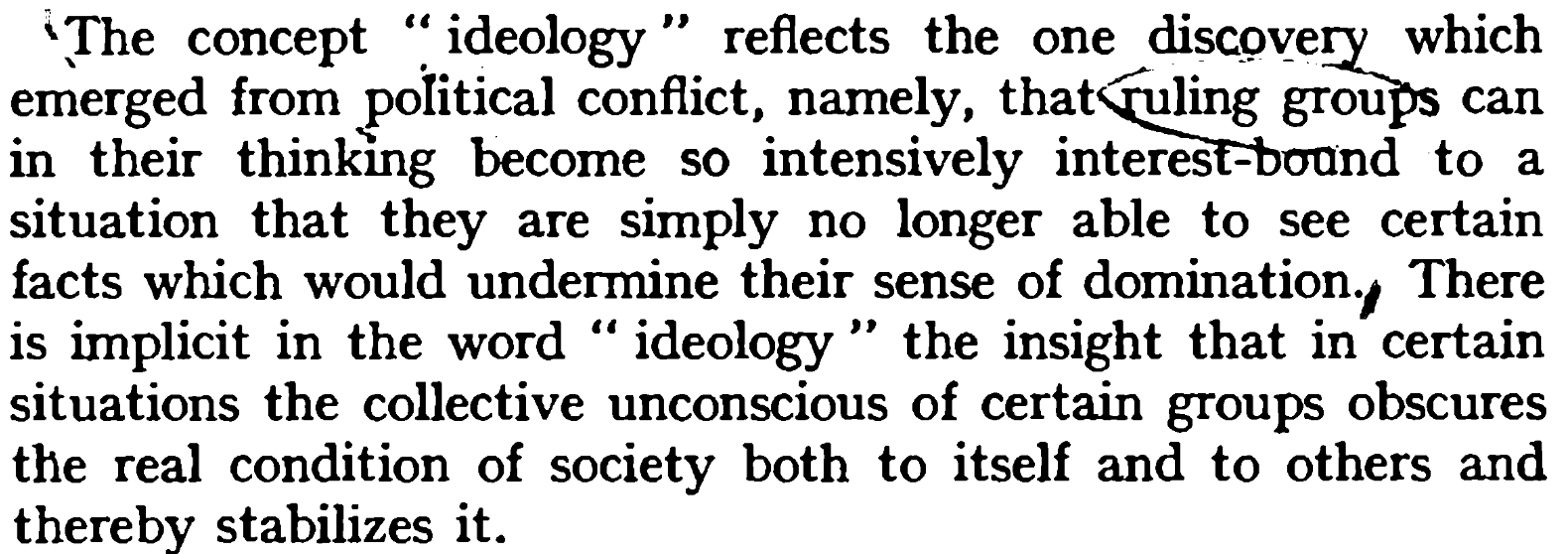
This brings us to the sociological concept of the orientation framework. Derived from the tradition of Karl Mannheim, Ralf Bohnsack, and Arnd-Michael Nohl, an orientation framework is not an ideology in the narrow sense, a set of explicit beliefs that could be argued for or against. It is something that everybody harbors beneath our surfaces: a tacit, action-guiding structure of perception.
Think of it as the “water” in which a social group swims without ever noticing it. This framework is grounded in shared life-worlds: the unspoken bond formed by shared biographies and milieus. In the case of the transatlantic elite, this means: attending the same universities, rotating through the same think tanks, using the same jargon, and fearing the same loss of status.
This shared experience creates a tacit knowledge which is a way of seeing the world that requires no explanation because everyone in the room already feels it. In this context, it determines, before any explicit argument begins: What counts as a “threat”, what counts as “security”, who counts as a “serious” interlocutor, what counts as “realistic” or “unrealistic”, what counts as “responsible” or “dangerous”,….etc.
Orientation frameworks are not reinvented every morning but we inherit them. Like a family heirloom or a corporate culture, they are historically sedimented patterns of perceiving the world that reproduce across generations. This transmission happens almost through osmosis in the transatlantic sphere: in elite education, in the curated memory of foundations, and through the embodied example of senior figures like Wolfgang Ischinger, who act as living archives of the Atlanticist worldview. Each new generation adds its own layer, adapting the language to fit new crises, but the core operating system remains remarkably stable.
Crucially, this shared worldview is not just a collection of abstract “ideas” floating in the air. It is always the expression of a very real, shared material existence. It arises from the specific neighborhoods elites inhabit, the boarding schools they attend, and the career paths that shuttle them between Washington, Brussels, and Berlin. Different factions—whether conservative or liberal, old money or new tech—may squabble over the details. But because they share the same position at the top of the hierarchy, they share the same fundamental instincts: the unquestioned assumption that the West is the natural center of the world, and that any threat to its dominance is an existential danger requiring a military and destructive response.
Strength vs. Sovereignty: The Framework in Action
Seen through this sociological lens, Whitaker’s brutal honesty is simply the articulate expression of the transatlantic elite’s internal logic.
When he says, “we’re not asking for European autonomy, we’re asking for European strength,” he is voicing the core tenet of the transatlantic orientation framework. Within this mental map, the distinction between strength and autonomy is not paradoxical but functional. Of course Europe should be strong: strong enough to bear the burdens of defending the eastern flank, strong enough to purchase American weapons, strong enough to integrate its command structures ever more deeply into the US-led architecture. But autonomy? That would imply the capacity to chart a different course, to say "No," to exist as an independent pole in a multipolar world. Within the framework of the Atlanticist elite, that is not a serious option.
Similarly, when Whitaker asserts that “interconnectedness is more important,” he is naming the concrete mechanisms of control: NATO command structures, US-led component commands, American weapons systems, shared intelligence pipelines, and digital interoperability standards. In the grammar of this framework, interconnectedness is simply the positive cipher for structural dependence—a dependence so deep and so habitualized that it no longer feels like dependence to those embedded within it.
And when Whitaker insists “we’re not trying to dismantle NATO... We’re trying to make NATO stronger,” he reveals the ideology of maintenance. This is the assumption that the existing architecture is the only possible reality, and that strengthening it is the only legitimate goal. To this mindset, peace is directly coupled to military capability—and only to it. Alternative security logics do not simply fail to convince; they fail to appear. They remain invisible because the horizon of thought is too narrow to include them.
Whitaker formulates a doctrine of simulated sovereignty: a condition in which a state possesses impressive military capabilities but has lost the capacity to determine its own strategic orientation. Europe may build muscles, but the nervous system and the brain remain American. It may spend more, arm more, take on more responsibility—but this strength must never be translated into the one thing that would make it sovereignty: the ability to say no.
Within this framework, the question “what if Europe developed genuine strategic autonomy?” does not arise. It is literally unthinkable. Why is it unthinkable? What gives this framework the power to foreclose alternatives even as its material foundations crumble? What allows it to grip minds that can clearly see the dependency but cannot imagine the exit?
To be precise: An orientation framework is specific to its carriers, its smaller social group. Naturally, the framework of a 30-year-old post-modern liberal advisor differs from that of a traditional conservative General. They may emphasize different codes: one speaks of “values-based rules” and “human rights,” the other of “hard interests” and “deterrence.” Yet, in spaces like the MSC, these elite fractions converge. Why? Because their differences are merely variations of the same operative logic. They speak different dialects, but they share the same underlying grammar. Whether liberal or conservative, they inhabit the same transatlantic ecosystem, circulate in the same institutions, and ultimately bow to the same strategic imperatives.
To understand what binds the liberal interventionist and the conservative hawk so tightly together at MSC, we must look beneath these surface variations. We must descend to the meta-framework: the sacralizing, dichotomous logic that lifts the West’s struggle from the realm of politics into the realm of civilization, morality, and even theology. And no speech at MSC 2026 revealed this meta-framework more clearly than Marco Rubio’s.
The Meta-Framework: The Return of Sacralized Violence
The orientation framework explains how elites perceive the world, what counts as a threat, what counts as realism. But it leaves a question unanswered: Why does this framework have such power to foreclose alternatives? Why do European elites, who can see the dependency and name its history, find themselves unable to imagine an exit?
To answer this, we must go deeper to what I call the meta-framework (or, following sociologist Karl Mannheim, “total ideology”). The meta-framework is the foundational structure of consciousness that determines what can appear as a question at all. In this particular context of transatlantic elites, it becomes the sacralizing, dichotomous logic that has recurred across Western history. In other words, this is about the cognitive machinery deployed whenever ruling strata needed to sanctify violence against those defined as outside the circle of humanity.
This machinery has profound roots. The philosopher Enrique Dussel showed in his book “The Invention of the Americas” that European modernity was born through the conquest of the Americas. This conquest required a narrative act of annihilation: the colonizers tried to replace indigenous worldviews with a sacralized, dichotomous framework that divided reality into superior and inferior, order and chaos, the saved and the damned. This framework justified their violence to themselves as well as to others; it sanctified it, transforming a brutal conquest into a holy mission.
The philosopher Silvia Federici traced how this same machinery was applied internally before in her book”Caliban and the Witch.” The witch hunts of early modern Europe were modern instruments for disciplining common people and destroying communal bonds. The same dichotomous logic that divided the world into Christian and heathen was turned against women, heretics, and commoners before the conquest of the Americas. This is the meta-framework: a recursive pattern of thought that reappears whenever ruling groups need to legitimize the violent restructuring of social orders. It was there in the witch hunts, in the conquest, in the civilizing missions of high colonialism, and in the Manichaean framing of the Cold War. And it is here now, reactivated for a new era.
Rubio and the Theology of the Bunker
No speech at MSC 2026 revealed this reactivation more clearly than Marco Rubio’s. In a keynote that functioned almost like a sermon, Rubio stripped away the technocratic language to reveal the theological substructure of the new era. He explicitly frames the current moment as a spiritual struggle for survival against “forces of civilizational erasure.” Is this the language of policy analysis or even policy prescription? Or does this sound more like the language of a religious war? This sentence fragment ultimately implies that the opponent is a force of erasure, and existential threat and not a state with competing interests, a community of people.
More (or equally?) horrendous is this part where Rubio roots the transatlantic alliance in an almost mythic blood-and-soil narrative:
“We are connected not just economically, not just militarily; we are connected spiritually and we are connected culturally. [...] The men who settled and built the nation of my birth arrived on our shores carrying the memories, the traditions, and the Christian faith of their ancestors as a sacred inheritance.”
Here, the meta-framework speaks to us directly. By invoking “Christian faith” as a “sacred inheritance,” Rubio sacralizes the political bloc. NATO is no longer a pragmatic arrangement, not a political entity, but it becomes a vessel of civilizational destiny. Within this logic, European autonomy is apostasy. It would mean severing the “spiritual” bond, rejecting the “sacred inheritance,” and aligning with the forces of erasure.
This sacralization serves a specific political function: it justifies the transition from hegemony (rule through consent and rules) to dominion (rule through hard power). Rubio explicitly declared the “rules-based global order” and the idea of being a “citizen of the world” to be a “dangerous delusion.” He mocked the “polite pretense that our way of life is just ‘one among many’” and dismissed international institutions like the UN as powerless. Instead, he celebrated raw force, citing American airstrikes and special operations as the only real solutions, contrasting them with “strongly worded resolutions.”
“It was American leadership that freed captives from barbarians... It was powerless to constrain the nuclear program... That required 14 bombs dropped with precision.”
The use of the word “barbarians” is a classic colonial trope, the necessary counterpart to the “civilized” West. It places the perceived enemy outside the realm of law and diplomacy, justifying any level of violence used against them.
Finally, Rubio’s speech confirmed the colonial boomerang diagnosed by Aime Cesaire (in his 1950 essay Discours sur le colonialisme): the violence and logic of the frontier returning to the metropole. Rubio explicitly framed the European social model, the welfare state, as a strategic liability. He attacked nations that “invested in massive welfare states at the cost of maintaining the ability to defend themselves” and demanded an alliance that “does not exist to operate a global welfare state and atone for the purported sins of past generations.”
This is the domestic face of the meta-framework. The colonial logic, which views populations primarily as resources for power projection, is now applied to the citizens of the West. Their healthcare, their education, and their social security are redefined as resources that must be extracted and diverted to feed the military machine.
Simultaneously, Rubio targets the internal enemy: the critical consciousness. By branding historical reflection as “shame” and environmental policy as a “climate cult,” he demands the ideological synchronization of the population. Dissent is part of the canon of “civilizational erasure.” This transforms the West from an Open Society into a Bunker State, an armed fortress that disciplines its own citizens with austerity and enforces ideological conformity. And what did the MSC attendees do? They applauded.
The European Voice Inside the Framework: The Paradox of Awareness
The previous sections have shown how the meta-framework operates at the level of US elite discourse through Rubio’s sacralizing rhetoric or Whitaker’s doctrine of simulated sovereignty. But this would be merely an external imposition that could be openly resisted if it were not also shared by European elites themselves. The question is: Do European defense intellectuals and policymakers see what is happening? And if they see it, why do they comply? The answers reveal how a meta-framework functions as internalized cognitive architecture.
First, we must discard the idea that all parts of the European ruling strata are naive or stupid. Their analytical community, from the foresight units of the Bundeswehr to think tanks like the SWP or DGAP, monitors US burden-sharing debates with considerable sophistication. They know the US government is pivoting to Asia. They fully understand that “burden sharing” often means “burden shifting.” Yet, this knowledge produces nothing in terms of action and plans to counter this development. This is what I call the conscious awareness paradox: Greater reflexive knowledge about US strategy does not break the framework but it reinforces it through practicality. But: Why? Because the communicative knowledge (the facts regarding US strategy) is processed through a conjunctive framework (the internalized habitus of the transatlantic elite).
Crucially, this compliance is not driven by a fear of abandonment. Strategically, European elites understand that the US needs European territory, logistics, and resources to counter Russia (and to get to China). The US is digging in. Rather, the compliance arises because European elites share the meta-framework. They resonate with US demands. When Marco Rubio speaks of a “civilizational struggle” against “erasure,” he is making explicit the tacit knowledge that European functional elites harbor beneath their technocratic language.
Within this framework, evidence that the US is pursuing its own interests at Europe’s expense is coded as the necessary price of civilization. Indeed, threats against European territorial sovereignty are understood as wake-up calls which they are grateful for (that much is true if anyone watches the MSC panel on the Arctic). They genuinely believe, tacitly or explicitly, that the West is a moral community under existential siege. US demands are interpreted as a call to duty and nothing else. “How do we do our part in the sacred defense of our way of life?” is the devout question on their minds.
González Laya: The Voice of the Paradox
The perfect embodiment of this paradox appeared at the MSC kick-off event in Berlin. Arancha González Laya, former Spanish Foreign Minister and dean of the Paris School of International Affairs, sat on the same panel as Whitaker. She heard his doctrine—”strong but not independent”—and responded with a confirmation of surrender or stoic acceptance (or however you want to call this):
“It was a choice that we made together a long time ago: that Europe would not have its own autonomous security. That the US would be the ultimate guarantor of European security [...] I don’t think we can de-plug from the US today.”
This is nothing but an admission of simulated sovereignty from within. González Laya explicitly names the historical choice: Europe decided decades ago not to build autonomous capacity for defense purposes. She acknowledges that this dependency is a structural inheritance. She sees the cage clearly. And then comes the crucial turn of phrase: “I don’t think we can de-plug.” Not “we should not,” not “it would be unwise,” but “we cannot.” The impossibility is simply assumed as a given. This is the framework speaking. Indeed, she adds: “And by the way, this is a bit what we are hearing from the other side, too.”
Why does a former Foreign Minister believe it is impossible for the EU to defend itself? The “impossibility” Laya articulates is the product of a specific socialization and structural symbiosis: Generations of European elites have been shaped by institutional continuity (NATO command structures), defense-industrial lock-in (purchasing US systems like the F-35), and elite socialization circuits (like the MSC itself). For Laya—and the class she represents—the transatlantic bond is almost like an identity. To “de-plug” would require more than building weapons; it would require dismantling the very cognitive structures that define who they are. Because their orientation framework has no category for a “West” without US leadership, the alternative of genuine autonomy does not register as a real option. It appears only as a dangerous fantasy. Instead we get talks about resilience:“But I think we want to be more resilient on the security and defense front.”
The prison, therefore, is the orientation framework itself. And it is precisely this internalized helplessness and at times ideological fervor that allows the US strategists to demand ever more, knowing that Europe will always interpret “burden sharing” as a duty.
The Burden-Sharing Ecosystem
The previous section showed that European elites are aware of the US strategy, analyze it, and yet they comply. Through the “conscious awareness paradox” we can understand that it is their internalized framework that codes their compliance with US demands and requirements as responsibility or even duty. But this paradox becomes even more striking when we examine the US side. The US power elites have built a sophisticated intellectual infrastructure designed precisely to research, theorize, justify, and optimize European compliance for best results in the extraction of their resources. This infrastructure operates openly, and at the MSC 2026, one of its architects was given center stage.
There is no “Bureau of Allied Tribute” or “Research Institute for Ally Compliance,” but there is a coherent research ecosystem spanning think tanks and universities, focused on a single problem: How can the US induce allies to pay more, to use more of their resoruces, freeing US resources for the conflict with China?
At the visible center stands Elbridge Colby, co-founder of The Marathon Initiative and now a key architect of Trump’s defense strategy. His work (e.g., The Strategy of Denial) provides the grand strategic framework: The US faces a gap between its global commitments and its capabilities. Therefore, it must ruthlessly prioritize China and force Europe to “shoulder the burden” against Russia. He is supported in this research aim by a network of scholars like Brian Blankenship (University of Miami), who theorizes the coercive diplomacy needed to pressure allies, and Jonathan Caverley (Naval War College) and Ethan Kapstein, who analyze the defense-industrial mechanics of dependency. (Of course, there are more researchers, institutes, that one could mention, and more of the specific aspects of the concept of “allied burden sharing” that are being researched, but I will just leave it that for now.)
I want to highlight one text by Brian Blankenship (University of Miami) which provides the tactical manual for how to execute it this burden sharing imperative. In his research on coercive diplomacy, Blankenship explicitly theorizes how the US can manipulate the fear of abandonment to extract resources from its allies. He writes:
“This paper compares two approaches to soliciting burden-sharing in U.S. alliances: retrenchment and conditionality. Retrenchment refers to reductions in the amount or timing of wartime assistance... Conditionality, in turn, relies on threats to abandon allies unless they increase their defense efforts [...] Conditionality is likely to be nearly as effective as retrenchment in many other cases, particularly those in which allies take the U.S. threat of abandonment seriously and there is a compelling external threat.”
Here, in his research, Blankenship openly acknowledges that “threats to abandon allies” are a primary tool for “soliciting burden-sharing.” The U.S. burden-sharing research sphere deliberately engineers this fear. They calculate precisely how much “conditionality” (threat of abandonment) is required to force European elites to divert their domestic budgets into U.S. weapons systems. And because the European elites operate within the meta-framework that has been historically sedimented, where the West is supreme and the outside world is a threat, they do exactly what Blankenship’s model predicts: they pay the tribute.
But, in essence, the threat of US abandonment, conditionality, has a deeper strategic obejctive: Saving US defense dollars is one of them but it is also about preventing the ultimate nightmare of the US imperial planner: a multipolar Europe integrated with Eurasia.
This reveals a fascinating crack within the transatlantic elite. In the early 2000s, European elites operated on a slightly different orientation framework, one that was more open to multipolarity and balance (evidenced by Eurasian trade integration and Nord Stream). The philosopher and historian Hauke Ritz argues this difference stems from deep historical baselines: The United States was born directly into capitalist modernity. Defined by a settler-colonial history, its foundational myth is entirely dichotomous: the “City on a Hill” versus the savage wilderness. For the US power elite, security is zero-sum; they lack the historical memory to process a true balance of power. Europe, by contrast, has a 2,500-year history predating the modern nation-state. Its historical memory knows that security comes from balancing different poles and finding equilibrium.
To the US elite, a multipolar world is perceived as an existential threat to their dichotomous, sacralized worldview. Therefore, “burden-sharing” demands and threats of abandonment were never designed to free Europe. They were designed to discipline it. The US uses these manufactured crises to shock European elites out of their residual multipolar tendencies, forcing them to reactivate the rigid, dichotomous US meta-framework.
This is the research and the historical disciplining that directly informs the National Defense Strategy and shapes legislation like the Allied Burden Sharing Report Act. And at Munich, this ecosystem’s results were presented as the new law of the land.
The Ecosystem on Stage
Matthew Whitaker made the connection explicit during the kick-off event, introducing Colby as the architect of this new reality:
“Under Secretary Elbridge Colby is coming; he is the perfect person to talk about the defense strategy in detail and about how the US is positioning itself towards Europe now and in the future. About capabilities that may ultimately need to be transitioned out of Europe and replaced by European capabilities. We’re going to continue to be engaged in NATO, but at the same time, we need to address our massive requirements in the Indo-Pacific.”
Colby himself then took the stage at another MSC panel (Double Trouble? Europe, the Indo-Pacific, and Connected Security Challenges) to articulate the logic. In a statement that blended technocratic planning with revealing colloquialisms, he stripped away the diplomatic veneer of the “partnership”:
“I just think in the right ways that are more practical. Like in the sense that—and not to bang on about this—but it is not one theater; things aren’t going to be in one place at one time. [...] But it means we’re planning; we’re saying, ‘Let’s all be in a place where we’ve got a good buffer of assurance.’ And I think that’s because we’re all ready. And of course the Americans are going to be everywhere, but we’re going to be doing it in a way that’s linked to practical military planning.
And then the other side—or whatever those other powers are—are all going to see that and they’re going to say, ‘Today’s not the day.’ I’m better off going with that stability model that we’re all talking about, where it’s better to keep jaw-jawing rather than war-warring,’ even if there’s a crisis or conflict in one or more theaters.”
This quote is the Rosetta Stone of the new transatlantic deal. When Colby speaks of a “buffer of assurance,” he is precise. A buffer is a shield; something that absorbs a shock so that what lies behind it remains untouched. In this architecture, Europe is a buffer. It provides the mass, the territory, and the conventional forces to absorb the shock of a potential war with Russia, creating the “assurance” that allows the US to focus its high-end assets elsewhere.
His assertion that “Americans will be present everywhere, but... linked to practical military planning” is the polite code for functional stratification. The US retains the nervous system (nuclear deterrence, space, high-end logistics), while Europe provides the muscle. When European commentators subsequently wrote that Europe must “invest extensively in its own power,” they were, advertently or not, signing up to be the buffer in Colby’s “practical planning.”
Senator Lindsey Graham supplied the economic logic that underlies this “alliance” in its crudest form. Speaking at the MSC in an event called “State of Russia,” he formulated the transatlantic division of labor with an honesty bordering on cynicism:
“We’re going to sell it. You’re going to buy it. So get an extra job. So what I want to do is make them (the Ukranian army) the most lethal force in Europe in perpetuity until Russia changes.”
This is the unvarnished economic reality: Europe pays. America sells. Ukrainians fight. The arrangement is “in perpetuity,” and it is presented as the state of things, just as they are. The numbers confirm Graham’s logic. Between 2022 and 2024, European NATO members spent 51 percent of their equipment budgets on US systems—nearly double the share from prior years. Europeans are buying themselves deeper into dependency while talking about autonomy.
Finally, the MSC revealed the human cost of this “burden sharing.” Hélène Conway-Mouret, a French Senator, brought the logic of the consequential scarcity management of such re-armament politics to the point with openness. She demanded that the population must be told it is necessary to “invest less in education and social issues” to redirect funds into armaments. In the same breath, she tried to sell this withdrawal of public funds as an economic stimulus program: arms spending creates “jobs.” This is the cynicism of the new era. The welfare state is sacrificed for military “resilience.”
This brings us back to the conscious awareness paradox. European analysts know Colby’s work. They know the statistics on US arms sales (the MSC report “Under Destruction” points this out). But because they share the meta-framework of the “West under siege,” they cannot read this as exploitation. They read Colby as a “serious strategist.” They read their US counterparts simply as “committed allies.” Even thouhg they might not all agree on the nuances of the reasoning behind policies: for civilization, for values, for human rights,…etc. The intellectual infrastructure of burden sharing works because the European orientation framework is already primed to accept it.
The theoretical subordination outlined in Washington is currently manifesting as physical reality across Europe. To understand the true extent of this transformation, we must leave the conference halls of Munich and look at the new military geography being constructed on the ground, before we get back to Munich.
NATO’s Command Architecture
Let us leave the carpeted floors of the Bayerischer Hof and look at the concrete. For while talk happens in Munich, facts are being created in the command structures of NATO that make any talk of European sovereignty a farce. Day by day, the meta-framework is being cast into steel.
Germany serves here as the case study, revealing a general pattern. As we now know, the transformation of Germany into NATO’s logistical hub was not a reaction to the 2022 “Zeitenwende.” A presentation by Brigadier General Gerald Funke, then Head of Planning at the German Ministry of Defence, given on June 8, 2017, in Ottawa, already sketched a world of bloc confrontation and used the term “Germany as a transit nation.” The plans were offered to the allies in 2017 as Germany’s role therein. That Funke today, as Lieutenant General, leads the Joint Support Command means he has moved from strategic thinker to engine room, concreitizing these plans. The meta-framework was guiding action long before the public narrative of emergency.
The Illusion of “Europeanization”
A particularly vivid example of simulated sovereignty is the recent restructuring of NATO’s command structure. The media celebrate that European officers are now taking over the Joint Force Commands (JFC) in Norfolk (USA), Naples (Italy), and Brunssum (Netherlands). Europeans, we are told, are assuming leadership responsibility. Here we see the narrative of European empowerment that masks US-dependency.
The key position in NATO is and remains the SACEUR (Supreme Allied Commander Europe). Since Eisenhower, this post has been held without exception by a US officer, who also leads the US European Command (EUCOM) in personal union. A single US four-star general thus integrates all US forces in Europe and all NATO troops under one hand. Here lies the operational decision-making power and the factual veto.
Under SACEUR sit the three Component Commands: Allied Air Command at Ramstein (Germany), Allied Maritime Command at Northwood (UK), and Allied Land Command at Izmir (Turkey). These are the single service commands that provide the warfighting backbone through air power, naval forces, land forces. They advise SACEUR, monitor readiness, and plug national forces into NATO plans. Until recently, there was at least the appearance of a division of labor: while air and land commands were US-dominated, the maritime command was in European (British) hands.
With the restructuring announced in February 2026, that last niche has fallen. For the first time, all three Component Commands—air, land, and sea—are now under undivided US leadership. The US generals in these posts act in personal union, commanding both NATO forces and the corresponding national US forces in Europe. This ensures that access to American resources, from satellite reconnaissance to nuclear weapons, always lies in one hand that reports directly to Washington.
While on the stages in Munich people talk of “more European responsibility,” the US has tightened its grip on the actual chain of command. It now controls physical warfare in every dimension, from air defense at Ramstein to fleet movements in the North Atlantic.
What the Europeans Get
What do the Europeans receive in return? They take over the leadership of the Joint Force Commands (JFCs): the regional coordination bodies in Naples, Brunssum, and remarkably, Norfolk, Virginia. These JFCs are permitted to lead military operations in the sense of managing them. But they do not possess the means to conduct them. They are structurally dependent on the US-led Component Commands for strategic logistics, aerial refueling, electronic reconnaissance, i.e. the data from satellites and drones without which a modern army is blind and deaf.
The division of labor is insidious: Europe assumes the risk. The JFCs are front-line commands. They stand in the line of fire and bear responsibility for the conventional defense of the continent. The US retains control. Through SACEUR, it controls overall strategy. Through the Component Commands, it controls access to the weapons systems that make strategy possible. Particularly revealing is the role of JFC Norfolk. That Europeans are supposed to bear responsibility here serves to secure US supply lines. Europe becomes the guarantor of the transatlantic bridge, ensuring that the US Army has unhindered access to the European theater at all times.
Stars and Stripes, the official newspaper of the US armed forces, recently described the posts that remain exclusively US-held—SACEUR—as the “bloc’s top military post”. This is precisely right. Here, decisions are made about how forces across the entire alliance are structured, integrated, and employed.
The US is optimizing its division of labor through these actions. It retains the “brain and nervous system” while offloading the “muscle work” and immediate political risk onto the Europeans. Even if Europeans now lead the regional JFCs, they must submit to US planning assumptions and American burden-sharing demands simply to remain capable of action. Europe is more integrated into NATO’s military architecture than ever before, yet cannot act strategically without US consent.
Logistics and command structures are only half the truth. Who commands the fire?
In Wiesbaden-Erbenheim and Mainz-Kastel, the US Army has reactivated the 56th Theater Multi-Domain Command. This is the brain of offensive US warfare in Europe, where cyber operations and long-range fires are coordinated. The stationing of weapons systems like Typhon (range over 1,600 km) and, prospectively, Dark Eagle (hypersonic) on German soil does not happen under German control.
When Defense Minister Pistorius sells this as a “bridge solution”, he deploys the classic rhetoric of the state of exception to create a permanent provisional arrangement. The result is the epitome of simulated sovereignty: Germany provides the territory and thus becomes the primary target of any Russian counter-strike. It becomes a launch ramp without a hand on the trigger. The 56th Artillery is the kinetic complement to the command structure.
The command structure, the missile batteries, the interoperability standards these all point to: The brain remaining American. SACEUR, the Component Commands, the 56th Artillery, all report to Washington. Europe assumes the risk. The JFCs, the territory, the populations, these bear the consequences of decisions made elsewhere. Interoperability is dependency. Each standard adopted, each protocol implemented, each word shared deepens the lock-in.
This is the material reality that the rhetoric of “European autonomy” obscures. The missiles are stationed regardless of what European leaders say in Munich. The command structure operates regardless of who leads the JFCs. The dependency deepens regardless of whether elites believe sincerely or perform cynically. The meta-framework is not just in their heads. It is in the concrete of Ulm, in the software of Ramstein, in the chain of command that runs from Wiesbaden to Washington. And until that concrete is broken, that software rewritten, that chain severed, the simulation of sovereignty will continue, regardless of what anyone says on any stage.
Differentiated Elites, Shared Meta-Framework
Before moving to the conclusion, we must address a question that attentive readers will have been asking throughout: if the meta-framework is so powerful, why do elites at the MSC appear to disagree so much? Why the arguments about spending, about command posts, about the tone of speeches?
The answer lies in a crucial distinction: orientation frameworks vary; the meta-framework is shared.
The transatlantic elite is not a monolithic cabal; it is a highly differentiated matrix. Now, bear with me, this model is still under construction, but: Vertically, there is a clear hierarchy: the US core (Pentagon, NSC, tech, finance) dictates the systemic parameters, the European Atlanticist core (Berlin, Paris, Brussels) translates these into regional policy, and the periphery absorbs the shocks.
Horizontally, the division of labor is equally complex. You have the knowledge producers: think tanks, the SWP, the MSC itself, writing the threat assessments that define the terms of debate. You have the military-security apparatus: NATO generals, defense ministry officials, drafting the OPLANs and translating political directives into operational reality. You have the economic elites: defense contractors, bankers, corporate sponsors, monetizing the crisis and profiting from permanent mobilization. And finally, you have the theatrical legitimizers and implementers: the heads of state and government delivering keynote speeches designed for domestic consumption, performing sovereignty even as they deepen dependency.
These groups have vastly different institutional locations and competing short-term material interests. The defense contractor wants profit; the diplomat wants stability; the politician wants reelection; the general wants capability; the think tanker wants influence. They argue over budgets, they bicker over command posts, they debate the tone of a press release. Some of them are conservatives, some of them are liberals, some of them are social democrats, some of them are nationalist,…etc. These are real disagreements, and they play out on the stages of the MSC every year.
This is where orientation frameworks operate. The diplomat’s orientation differs from the general’s, which differs from the banker’s. The European Atlanticist’s orientation differs from the US core’s. These variations matter; they produce different assessments of risk, different preferences for action, different senses of what is politically possible in the moment.
But beneath all this diversity lies the meta-framework: the deeper structure that makes all these varied orientations recognizably similar. It is the assumption that the West is the natural center of the world, that the multipolar challenge is a threat to be managed rather than a condition to be adapted to, that deterrence is the only serious language of security. It is the dichotomous, latently violent, hierarchized logic that divides the world into “us” and “them,” into civilization and barbarism, into the Shining City and the Axis of Deplorables. It is a historically grown logic born out of Western modernity.
The diplomat and the general may argue about budgets. The European and the American may bicker about command assignments. The politician and the banker may have different time horizons. But none of them questions the framework that makes these the only questions worth asking. None of them imagines a world without NATO, without the US guarantee, without the binary of threat and response. None of them can see the cage because they are looking through its bars. (However, I would argue, that the whole burden-sharing tactics did iron out those that could have been potentially dissenters within the European elite sphere. Those that do not share the meta-framework in the same dichotomous, radicalized way.)
This is why the MSC functions as it does. It is the place where differentiated elites with their different orientation frameworks, their different institutional locations, their different short-term interests, come together to synchronize their worldviews and converge on practical compromises. The Europeans get the JFCs; the US keeps SACEUR. Europe spends more; the US maintains escalation control. Everyone gets something. And the meta-framework remains intact.
The quarrel is real. The family is real. But the family’s fundamental assumptions, about who belongs, who threatens, what counts as security, are never questioned. At least not in the way the “family” is currently structured. That is the power of the meta-framework. And that is why the Bunker State continues to be built, even by those who might wish, in their quieter moments, for a different world.
Closing Notes: The Trap of the Framework
The ritual synchronization of this worldview was provided by Wolfgang Ischinger in his closing remarks. First, he simulated pluralism by acknowledging that there had been “doubts” over the weekend. But immediately, he neutralized them, making clear that these debates must remain inconsequential:
“What we need now is more than just another series of speeches. What we need now is a plan, is action.”
With this, Ischinger confirmed the true character of the conference: The discussion space is a simulation. One may doubt, one may debate, but in the end, the outcome has been determined: rearmament and deeper integration into US structures are presented as without alternative. To cement this, he approvingly quoted Marco Rubio and Friedrich Merz. When the German Chancellor himself tells Ischinger that the already bleak diagnosis of the “Under Destruction” report is “not strong enough,” the dynamic becomes undeniable. The political leadership are actively driving the politics of fear to legitimize this state of exception.
Existing theories explain pieces of the puzzle: epistemic bubbles, elite reproduction, securitization, alliance politics, historical sociology. Here, this framework is an attempt to serve as a vital theoretical bridge, particularly in connection with Marxist thought. Marxist analysis correctly identifies that an economy is fundamentally based on social relations, and that the material conditions of a ruling class dictate its political project. But to understand how this class reproduces its hegemony today without relying on overt, mustache-twirling conspiracies, we must map its cognitive architecture.
This is what the Bunker State framework tries to add (a part of that framework, because there’s still more to it). It shows a causal chain: A sealed epistemic bubble (the condition of the present, grounded in the shared material existence of neoliberal stratification) generates a specific orientation framework (a process of socialization). Over time, this hardens into a meta-framework (the deep, historical, ideological structure), a sacralizing, dichotomous logic reaching back to colonialism and witch hunts, which codes multipolarity (as a non-dichotomous system) as an existential threat. Finally, this meta-framework drives the material construction of the Bunker State: the subordination of entire societies to permanent military mobilization, all while appearing to those inside the bubble as simple “realism.”
When we piece together the puzzle, the ideological priming by Rubio, the material infrastructure in Ulm and Wiesbaden, the bureaucratic penetration of OPLAN DEU, a frightening picture emerges. The talk of “European autonomy” is merely a calming pill. In truth, Europe is locked into a system of permanent subordination: militarily through US command structures (SACEUR), technologically through digital interoperability, and economically through the obligation to purchase US armaments. Europe has maneuvered itself into a position where it is materially incapable of saying “No.” She cannot move her troops without NATO software, nor defend her airspace without US systems. And how to conduct an independent foreign policy when the infrastructure is already planned as a staging area?
This is a class project as a structural outcome of an elite whose shared material and cognitive existence has severed them from the populations they govern. The functional elites in Berlin and Brussels may genuinely believe they are partners at the table of power. In truth, they are administrators of decline, selling military foreign control as sovereignty. But when Matthew Whitaker says, “We expect you to do more and not be independent,” it is also an admission: The rulers (or some of them) know that their order is based on dependency.
Because this is a structural, cognitive prison, the work on an alternative does not begin with appeals to this ruling class. We cannot persuade them. They cannot hear us, partly because their framework possesses no categories to process what we might say. Inside their bubble, counter-arguments are automatically recoded as “disinformation” or “appeasement.” As long as we remain trapped in the Munich bubble, where “discussion” is merely the prelude to obedience, we will continue to serve interests diametrically opposed to our own.
The task, therefore, is to build alternative conjunctive spaces. We must create spaces where different orientation frameworks can grow, where Europe’s longer historical memory of multipolarity and balance can be cultivated, and where different visions of the future can take root.
The prison is not only made of steel and concrete. It is made of categories so deeply internalized that they no longer appear as categories at all. A prison of the mind.
Closing Thoughts & Musings
I sometimes ask myself what this type of thought experiment accomplishes, if anything. What’s the point? Why even talk about such concepts as orientation frameworks and epistemic bubbles? Most people intuitively understand what I’m describing here anyway. They know that elites live in a different world, that they speak a different language, that they seem incapable of seeing what is obvious to everyone else.
But I think, there is still something to be gained:
First, the MSC was a wonderful example to use this lens, a concentrated case study of one of the parts of the Bunker State in action. It shows how the meta-framework now operates in plain sight, on stages, with standing ovations. In the media, too. Second, think of any problem or idiocy in the world right now caused by transatlantic ruling strata: armament, the cutting of welfare, the crushing of dissent through sanctions, sanctions regimes, warfare at sea—the list goes on and on. Use the lens provided here and apply it. It might provide a bit more clarity. Or so I hope.
But clarity is not an end in itself. I hope that understanding the mechanisms and structures a little better will also mean being able to find ways of resistance and collective action that break through these walls. Maybe, if crisis hits in these latitudes, if we know what we’re up against, we know what not to do when a window opens; so that we do not repeat everything again and continue this cycle of violence.
If ideology were just a “fog,” it could be blown away by enlightenment. Better arguments, more facts, more truth, these would be enough. But if the frame of reference arises from material practices (careers, networks, logistics, institutions), then the conclusion from the analysis is that we cannot change consciousness through better arguments alone. We can only change it through different social practices.
We must create counter-milieus. We must create spaces in which people have different experiences, go through different biographies, develop different dependencies. We must build alternative conjunctive spaces where new orientation frameworks can grow, because they are lived into being.
There is always a way out. This is a historical process like many others before. The Bunker State was built; it can be unmade.
I am also still working on the other essays about the Bunker State, a theory under construction.
Lastly, as a cruel dessert with coffee or tea, please consider the following statements.
First, from the Bundespressekonferenz, directed at critical journalist Florian Warweg:
“By the way, Mr. Warweg, I am also grateful to you for repeatedly making it known that these sanctions exist and that there is such a sanctions regime. Because one thing is clear: those who abuse it [freedom of opinion and the press], must be aware that this entails costs and what they can expect as a consequence.”
Incredible, but true. Like so many other things that are now spelled out, audibly and visibly. Those who step outside the permitted boundaries must expect “costs.” The threat is delivered in public, to a journalist, as a warning to all.
And this one, from the MSC Defense Townhall, by Latvia’s Foreign Minister Baiba Braže, foreshadowing the future and the logic behind such statements:
“On the internal security side, how do we limit Russia’s influence? Awareness. Whole-society understanding of the threat. It is a threat to us as a society, whether it’s elections, whether it’s the views—how we take into account the views from our societies—but also be very open and honest with our people. …
And on far-right and left groups, I have difficulties to answer. We don’t have them in Latvia because, again, if there are indications that there are threats to the security of our democracy, our security services are entitled to have conversations with people. Because there is a very strict limit: freedom of speech versus subversive activities and a possibility of an armed action. So we take it very seriously.”
No comment.
Addendum
These are the Notes that partly touch upon the topics discussed here:
The Script vs. The Stage: Analyzing the Transatlantic Elite (Do look at the comment section for a more theoretical deep dive.)
Is neoliberalism actually "dead"? Or has it just stripped off the mask? (This is an audio.)
US Strategy demands Subordination (Note on the MSC 2026)
The Epstein Sphere as an Example of a Decaying Ruling Strata’s Conjunctive Space
Published as a shorter version first in German on NachDenkSeiten (part 1 and part 2).
Join the Conversation
If this analysis is correct, if the meta-framework of dichotomous, sacralized conflict binds even those elites who see the trap, then we must ask what this means beyond Munich.
Do you observe this dynamic in your own region? Is the “simulated sovereignty” your leaders perform, the rhetoric of autonomy masking deeper dependency, visible in your local landscape? Have you encountered the conscious awareness paradox: people who can name the trap but cannot imagine escape? The Bunker State is built in every decision to prioritize military “resilience” over social provision, in every sanction against dissenting voices, in every “conversation” that reminds citizens of the costs of stepping out of line. Where do you see the cracks? Where do you see resistance? Leave a comment below.
Support Independent Analysis
To map the architecture of the Bunker State, and to see the convergence where others see only rift, one must operate from a space outside its logic. This project relies on the freedom to research without the institutional filters that mistake surface disagreement for genuine fracture. Your support, whether through subscribing, sharing, or a direct contribution, fuels the hours spent decoding the meta-framework, tracing elite synchronization at events like the MSC, and exposing the mechanisms that bind even those who see the trap.
I am deeply grateful to every paid subscriber. Your belief in this work allows me to dedicate myself full-time to breaking the silence of the managed consensus.
Subscribe to join a community committed to long-form, qualitative analysis of the forces building the Bunker State.
Share this essay. If the mainstream narrative obscures the reality of elite convergence behind the rhetoric of rift, debate and dissemination are the necessary antidotes to the shrinking corridor of opinion.
Contribute directly via Ko-fi. If this analysis provided clarity on how the meta-framework operates, consider supporting the rigorous work of dissecting its machinery.
By subscribing or sharing, you help sustain an independent inquiry into the forces dismantling the old world and constructing the new. Thank you for being part of this.
Stay Connected
Bluesky: @themindness.bsky.social
X: @noirnen
Stay curious,
Nel
Thanks for your helpful research into Military Elite's Mental Bubble.
You ask the question: "Why do highly educated European elites actively cheer for the destruction of their own sovereignty?" Allow me to draw your attention to Steven Newbury's analysis of the same question:
"When the European elite gave a standing ovation to Marco Rubio’s ‘love letter to colonial conquest’ in Munich, many observers were baffled. Why would the leaders of the EU—a project ostensibly built on peace and sovereignty—cheer for a speech that reduced them to junior partners in a US resource raid?
The answer lies in a brutal class distinction. The European elite are not confused; they are calculating. They have recognised that the European Material Base (industry, cheap energy, the welfare state) is collapsing due to the loss of Russian gas and the thermodynamic reality of the Resource Entropy Singularity [shrinking energy returns on energy investments].
Faced with a dying host, the parasite seeks a new one.
When the internal energy surplus collapses, the cost of maintaining the social contract—democracy, the welfare state, and industrial employment—becomes thermodynamically unaffordable. The elite are then faced with an existential binary choice. They can either sink with their population by attempting to maintain the welfare state on a shrinking energy budget, or they can decouple.
The applause in Munich signals that the decoupling has occurred.
By aligning with the US Empire, the European leadership has detached its personal fortunes from the European economy. They have transformed themselves into Compradors—local managers acting on behalf of an external Imperial power, charged with managing the extraction and pacification of their own territory for the benefit of the Core."
https://theuaob.substack.com/p/the-comprador-calculus-why-europes
Nel, excellent and rigorous analysis. It confirms many of the structural mechanisms we have both described — from soft power and cultural dependency to hard military integration.
Understanding these layers of influence and cultural colonialism is essential, as outlined in Good Morning, Europa: A Suicide Note – and a Survival Guide. ttps://www.amazon.de/dp/B0G1LYRP1S
But analysis alone risks becoming a spectator sport. Without civic action and democratic verification, nothing changes.
Libertas Europa is an attempt to move from diagnosis to sovereignty of each of us. https://libertaseuropa.eu/