

The Imperial Feedback Loop
Beyond the "Lobby vs. Proxy" Debate: How Neoconservatism Fused US Hegemony with Israeli Strategic Culture


Note to Readers: You might normally see a piece like this floating in the Notes section, but it quickly outgrew that format! I’m trying out something new: publishing these "in-between" thoughts as shorter, distinct essays for better readability. I use these pieces to organize my analytical frameworks before building them out into my usual long-form essays. I'm still working on the deep dives, and I'll keep using Notes for quick, off-the-cuff observations.
The current US and Israel-induced war on Iran has brought an old debate back to the forefront: Mearsheimer’s “Israel Lobby” thesis versus the “US empire uses Israel as a proxy” thesis championed by analysts like Berletic. Engaging with this is neither an abstract nor a fruitless exercise; it is foundational for understanding the structural forces driving an escalation that could have global ramifications. Yet, from my perspective, pitting these two theses against each other is less a binary contradiction than a false dilemma.
I want to offer a third, synthesizing position: Israel is a functionally radicalized proxy that has also served as an ideological and military-operational laboratory and role model for a specific faction of the US ruling strata (neoconservatism and securitocrats), producing a feedback loop in which US imperial strategy and Israeli state logic have become mutually constitutive.
The Mearsheimerites correctly identify a real, disproportionate lobbying power, while Berletic correctly observes that this power operates within a pre-existing, historically imperial US framework. The critical missing layer is the ideological transfer mechanism, where neoconservatism acts as the transmission belt between the two. Furthermore, the distinct social-anthropological history of the Jewish diaspora, specifically its historical capacity for dense, resilient networking, provided structural tools that were instrumentalized by a specific, right-wing radicalized Zionist faction. It is this political co-optation by a radicalized subset that amplifies that influence within the US political system.
Mearsheimer and Walt: The Lobby Thesis
Mearsheimer and Walt’s foundational argument is that U.S. foreign policy in the Middle East has been significantly shaped by a “loose coalition of individuals and organizations who actively work to steer U.S. policy in a pro-Israel direction”. Their central provocative claim:
“No lobby has managed to divert U.S. foreign policy as far from what the national interest would otherwise suggest, while simultaneously convincing Americans that U.S. and Israeli interests are essentially identical”.
The book, published in 2007, documented AIPAC’s outsized influence in Congress and executive branch hiring, as well as the effect on academic discourse.
The empirical documentation of lobby mechanics is, of course, sound. The limitation of this argument, nonetheless, is structural. It pesents US foreign policy as having a pre-lobby, rationally-defined “national interest” that is subsequently distorted. This is a realist assumption that ignores how the interests of the US imperial system and more specifically of its power elites are themselves ideologically constructed. More precisely, that which is ideologically constructed is not necessarily rational nor realist.
And this is precisely the point the “Israel as a proxy” thesis exploits. The Lobby thesis also struggles to explain why the US pursued Middle East destabilization long before AIPAC reached its current power, and similarly why US grand strategy toward Iran is so congruent with objectives that predate the lobby’s peak influence.
Structural Imperialism: The Proxy Thesis
The counter-thesis (Israel is a proxy) is rooted in a structural reading of US power: the US has been exterminating indigenous populations, stealing land, and extracting resources for nearly 200 years before Israel existed, and as Berletic states: “the idea that ‘Israel’ somehow got the ruthless, racist thieves running the US to bend a knee to ‘them’ is an absurdity at face value”. Indeed, Wall Street (arms, oil, tech, pharma) spends vastly greater sums on lobbying than AIPAC, and it remains dominated by nominally Christian men. Israel, in his framing, is one of many proxies, analogous to Ukraine, cultivated by the US power elites to project power with plausible deniability.
This argument is strengthened by the historical record: the US backed Saddam Hussein’s Iraq in its war against Iran in the 1980s, orchestrated the 1953 CIA coup against Mossadegh in Iran, and has pursued Iranian regime change across every presidential administration of the 21st century.
The limitation of this thesis is its tendency toward monocausality: by reducing Israel purely to a US tool, it understates how the ideological internalization of Zionist Israeli methods by parts of the US ruling class created genuine institutional feedback loops that are not merely instrumental. The proxy does not just execute strategy but actively shapes the strategic imagination of the principal. Stated differently: this is a dialectical process. One is shaped by the other and vice versa.
The Neoconservative Synthesis: Where the Two Camps Meet
Neoconservatism emerged in the late 1960s and 1970s among former liberal hawks who became disenchanted with the New Left and what they, additionally, saw as dovish tendencies in the Democratic Party. As historian David Gibbs argues, it was specifically an outgrowth of America’s failure in Vietnam and thus, an effort to reinvigorate American militarism after its catastrophic deflation. The movement migrated from the Democratic to the Republican Party over the course of the 1970s-80s, eventually capturing the Bush administration.
Critically, while neoconservatism was never exclusively Jewish, its intellectual origins were deeply rooted in the largely Jewish milieu of 1930s and 40s New York—specifically among Trotskyist academics who later migrated to the political right. In the shadow of the Holocaust, this group came to see Israel’s survival as a direct measure of the West's global stability. Though not a religious movement, it was disproportionately pro-Zionist from its inception because Israel embodied a very specific strategic ideal: a state willing to deploy military force unapologetically, offensively, and, at least in its own mythology, successfully.
The Ideological & Operational Model
The neoconservative project was never just about traditional lobbying; it was about testing, observing and internalizing a specific operational model through Israel. What I’m trying to convey is that Israel did not invent the military logic its state carried out entirely on its own. Rather, its strategic posture is historically founded in the broader logic of Western settler-colonial states and their expansionist imperatives; a history it shares with the United States. Because of its geopolitical position, however, Israel evolved into a highly active laboratory for military strategy and technology, a status recognized even by institutions like the CSIS. For neoconservatives, this laboratory demonstrated the efficacy of using maximal force offensively, disparaging diplomacy as weakness, and treating hypothetical threats as grounds for preemptive war.
Therefore, when we see traces of the 1967 preemptive strike logic or a variation of the “never again” existential framing in US grand strategy, we are seeing a structural convergence. Israel functions as a model US imperial project operating without similar institutional constraints and stripped of domestic political friction. The neoconservative vision was to take the lessons learned in the Israeli laboratory and transfer that unhindered freedom of offensive action back into the US system.
The Clean Break and Yinon Plan
The structural convergence of US and Israeli strategic interests is best illustrated by the 1996 “Clean Break” paper , authored by neoconservatives Douglas Feith, Richard Perle, and David Wurmser, which presented to incoming Israeli Prime Minister Netanyahu a strategy for Middle East destabilization that was effectively a US neoconservative vision dressed in Israeli strategic language. The earlier ideological precursor was the 1982 Oded Yinon plan, which argued that Israel’s survival required becoming a regional imperial power by fragmenting neighboring Arab states into smaller, ethnically and sectarianly fragmented entities. The dissolution of Iraq, Syria, Jordan, Saudi Arabia , the very states subsequently destabilized by US military interventions, was the blueprint:
“Lebanon’s total dissolution into five provinces serves as a precendent for the entire Arab world including Egypt, Syria, Iraq and the Arabian peninsula and is already following that track. The dissolution of Syria and Iraq later on into ethnically or religiously unqiue areas such as in Lebanon, is Israel’s primary target on the Eastern front in the long run, while the dissolution of the military power of those states serves as the primary short term target."
So, it is not that Israel told the US to do this, to think in terms of trying to fragment and attack other countries. It is that the neoconservative faction within the US ruling strata shared and share the same fragmentationist logic as the Israeli right, both for their own reasons. The US version is that states that are too large and independent cannot be controlled (an essay about this in the works), and must therefore be destroyed and fragmented. The Israeli version, the Yinon logic, is that regional fragmentation into weak, warring ethnic and sectarian mini-states neutralizes existential threats to Israel but also serves to consolidate over resources in the region. These two logics are structurally isomorphic; consequently, neoconservatism and Likudnik Zionism continue to generate policy outcomes that are effectively indistinguishable.
A Synthesis: Radicalized Colonial Ideologies
How does a state become an ideologically radicalized proxy in the first place? The answer is through the injection of and support of a constructed, radicalized ideology. Zionism was a product of late 19th century European nationalism, and it received decisive imperial backing first from imperial Britain’s 1917 Balfour Declaration, which was explicitly a colonial-strategic maneuver. Britain needed a loyal presence in Palestine as the Ottoman Empire collapsed, and as Britain’s military governor of Jerusalem bluntly put it, Israel was to be “a loyal Jewish Ulster in a sea of potentially hostile Arabism”.
The US inherited and intensified this colonial logic after World War II, funding, arming, and diplomatically shielding Israel while systematically working to prevent pan-Arab nationalism from coalescing into a regional power capable of controlling its own resources. Zionism was thus doubly constructed: first as a response to real European antisemitism (a genuine ideological force rooted in centuries of persecution), and then as a useful instrument selected and amplified by the Anglo-American imperial system precisely because of its inherent settler-colonialist logic of exclusive territorial possession.
The Diaspora’s Social-Anthropological Amplifier
An important and frequently elided factor in these debates is the social-anthropological architecture of the Jewish diaspora. Centuries of systemic exclusion, persecution, and expulsion across Europe forced Jewish communities to cultivate extraordinarily dense, transregional networks of mutual aid. These were complex kinship systems spanning continents, sustained through commercial partnerships, rabbinic succession, and diplomatic brokerage. Crucially, these networks were not the product of conspiratorial design, but rather social-historical adaptations born of structural necessity: marginalized communities under continuous threat inevitably develop resilience through high network density.
In the modern US, this heritage translated into a profound, historically grounded capacity for political and cultural organizing. We must, however, draw a hard line between Jewish communal organizing, a diverse civic spectrum that includes anti-Zionist factions, and Zionist political lobbying, which is a specific, modern geopolitical project. The persistent conflation of these two distinct categories is what makes the current transatlantic speech-law dynamic so insidious. It weaponizes the genuine issue of antisemitism to shield a state-driven political project, functionally silencing both external critics of Israel and internal Jewish dissent against Zionism.
A Note on Christian Zionism
I will not delve into the origins and logics of Christian Zionism here (that might be reserved for another article or essay), but I do want to briefly note something that must be considered: while Christian Zionism could, on the surface, be understood as mere pro-Israel sentiment, there is a bit more to it. It intertwines religious conviction with a military, strategic, and even economic agenda, asserting that US support for Israel’s expansion is simultaneously biblically mandated and materially in America’s strategic interest. Its theology is eschatological. This belief that the ongoing conflict in the Middle East is part of God’s divine plan for the End Times makes Christian Zionists uniquely immune to cost-benefit reasoning about military strategy, and consequently incredibly useful for quasi-suicidal military doctrines and operations.
The current Trump administration is saturated with Christian Zionists: Defense Secretary Pete Hegseth, US Ambassador to Israel Mike Huckabee, and House Speaker Mike Johnson have all embraced this ideology (Johnson, for example, has explicitly defended Israeli settlement expansion as biblically foretold). This creates a second layer of Zionist political pressure that is institutionally distinct from AIPAC and Jewish-Zionist lobbying. From the perspective of US imperial strategy, Christian Zionism provides a potential domestic mass-mobilization capacity for a foreign policy that Wall Street and the military-industrial complex require anyway, making it an extraordinarily effective tool. In other words, Christian Zionists are being mobilized toward ends that serve the military-industrial complex and US hegemonic strategy, not the theological Rapture they believe they are advancing. The open question is whether this dynamic has developed its own self-reinforcing logic that could potentially escape rational management.
The Think Tank Network as Structure
The neoconservative-Zionist-evangelical synthesis emerged structurally enabled by the Powell Memorandum network. Lewis Powell’s 1971 confidential call to arms for corporate America provided the blueprint for an aggressive new think-tank infrastructure, most notably the Heritage Foundation, the American Enterprise Institute (AEI), and the Cato Institute. Over the following decades, these institutions systematically reshaped the US academic, media, and political landscapes in favor of militarist, anti-regulatory conservatism. By allying the Christian Right and neoconservative intellectuals with the financial elite, this network moved not only the Republican Party to the right, but successfully captured large portions of Democratic foreign policy as well.
This is the structural context that makes the proxy-thesis argument so compelling: the material interests of Wall Street (arms, oil, tech) were already pushing for an aggressive Middle Eastern strategy, regardless of the Israel lobby. The Powell network simply fused these material interests with an ideological superstructure (neoconservatism + Christian Zionism) capable of manufacturing mass consent for what was otherwise naked resource extraction and hegemonic strategy. We see the zenith of this today: the Heritage Foundation, deeply embedded in the current Trump administration through initiatives like Project 2025 and the anti-Palestinian blueprint “Project Esther,” now serves as the primary institutional transmission belt turning Christian Zionist theology into hardline US imperial policy.
The Four-Layer Model of Structural Convergence
Synthesizing these historical and structural developments we have mapped out so far provides us with a clear analytical lens: a framework comprising four distinct but mutually interacting layers, outlined in the table below:
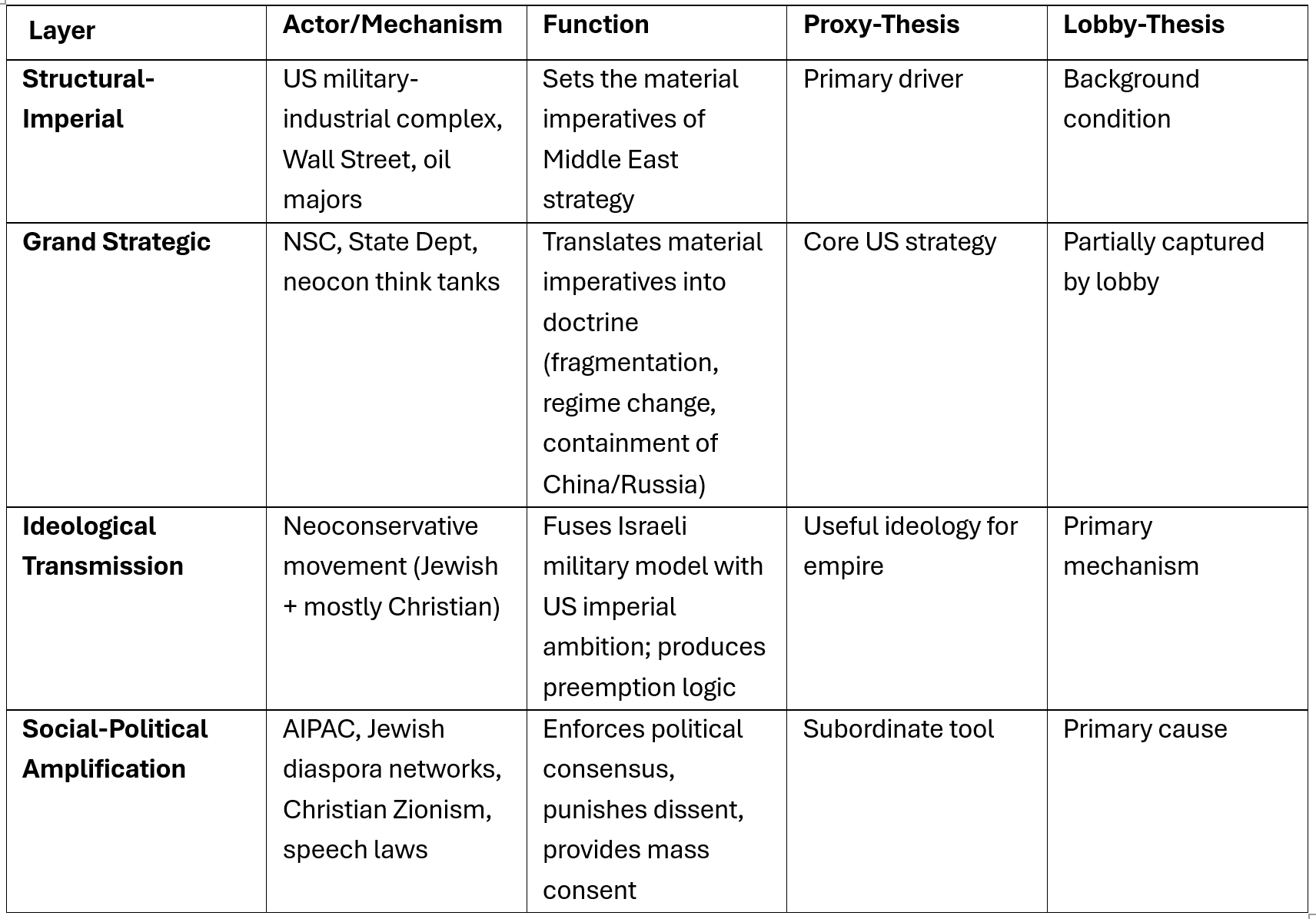
The key insight here is that these layers are mutually reinforcing rather than strictly hierarchical. Analysts who emphasize Layer 1 correctly identify the structural foundation, while Mearsheimer rightly points out that Layer 4 is operationally powerful. However, both camps struggle to adequately theorize the feedback mechanism at Layers 2 and 3. This is where the ideological model of Israeli military practice, rooted in a shared settler-colonial logic, was internalized by US ruling-class factions well before, and entirely independently of, lobby pressure (which then led to the warfare laboratory practice). That pre-existing ideological convergence is precisely what made the later lobby work so extraordinarily effective.
Note on Iran
We can see the clearest real-world application of this model in the current US-Iran confrontation. The unbroken continuity of US policy toward Iran across all 21st-century administrations strongly suggests this posture is not dictated by the shifting domestic lobbying of any single presidency, but by an overarching structural imperative. As the largest independent state actor in the Middle East defying external control, Iran, according to the fragmentationist grand strategy thesis (I am currently working on), must be either structurally destabilized or entirely destroyed.
The roles here are clearly distributed across four layers. The Israeli dimension is operational: it acts as the forward pressure-application mechanism, supplying localized strike capabilities and intelligence infrastructure while catalyzing Iranian responses used to justify US escalation. The Christian Zionist dimension acts as the engine for ideological mass mobilization. The neoconservative dimension supplies the doctrinal legitimation through its hypothetical threat logic. Yet, beneath it all lies the material logic: securing Iranian resources, denying that vital energy flow to China, and geopolitically isolating Russia. That material imperative is the structural bedrock upon which every other layer rests.
Closing Notes: The Feedback Loop of Chaos
The US-Israel nexus, analyzed through this lens, offers several implications that help us understand the current geopolitical situation. First, the radicalization of proxies (but also of “specialists of violence” and the masses themselves) could partly be a deliberate strategy whose outcome is difficult to envision (and perhaps difficult to control). The Anglo-American imperial system actively selected and amplified the most maximalist, exclusionary variant of Zionism (the Likudnik-settler strand) as the operationally useful one, while tolerating but not empowering more moderate or non-Zionist Jewish political expression. This pattern is generalizable: imperial systems tend to radicalize proxies in ways that make them functionally dependent and ideologically committed. This is even more true the closer an empire senses its own decline.
There is also the ideology-institution feedback problem. Once an ideology is institutionally embedded (in think tanks, military academies, political parties, and congressional staffs), it develops its own reproduction logic that can partially escape the control of the material interests that originally sponsored it. Thus, the question of whether Christian Zionism has developed its own autonomous dynamic is theoretically important, because institutions can become path-dependent in ways that constrain even their original sponsors.
Furthermore, the enforced silence on Israel-Palestine in US academia can be understood as the product of a convergence of interests: neoconservative ideologues who need the Israeli model protected from critique, military-industrial complex actors who need the political consensus for Middle East strategy maintained, and Zionist organizations leveraging the legitimate moral weight of antisemitism to foreclose critique of a political project. The speech law is the point at which all four layers interact most visibly.
The US and Israel have a historically constructed and politically maintained relationship. It is better understood as a co-constitutive strategic symbiosis in which each partner has some agency (though the US has significantly more, just by the sheer nature of its material and territorial scale), genuine interests, and a genuine capacity to shape the other—but within a power asymmetry that is not in question. Israel without US backing cannot survive; the US can exist without Israel but has structurally chosen not to, because Israel performs functions in the Middle East that would be far more costly to replicate through direct US military presence alone.
Ultimately, the more productive framing is that both schools (the proxy and lobby theses) are measuring different layers of the same system. What is missing from both is the ideological transfer mechanism, where neoconservatism serves as the conduit.
Addendum
These are the Notes that partly touch upon the topics discussed here:
The current unprovoked and so-called “preventive” attacks by the US and Israel on Iran
A Question of Time: Why the U.S. Strategy in Iran is Deliberate (and Dangerous)
Join the Conversation
If this framework holds, if the meta-structure of US-Israel relations is actually a co-constitutive feedback loop that binds the empire to a radicalized logic, then we have to look at how this impacts our own societies.
Do you see this institutional path-dependency happening around you? Have you noticed the “laboratory” effect, where the militarized, unconstrained tactics of the proxy are slowly imported back into domestic policing, politics, and foreign policy? Have you encountered the specific speech-law dynamics we discussed—the point where the military-industrial complex, neoconservative ideology, and the weaponization of antisemitism converge to silence dissent? The Bunker State is built locally in every decision to prioritize hypothetical military threats over domestic stability, and in every attempt to crush the political imagination. Where do you see this ideological transmission belt breaking down? Where do you see resistance? Let’s discuss in the comments below.
Support Independent Analysis
To map the architecture of the Bunker State, one must be able to operate outside of its institutional path-dependencies. As we discussed regarding the enforced silence in academia and media, this kind of analysis relies entirely on the freedom to research without the filters of the military-industrial complex or the speech laws that protect geopolitical projects from critique.
Your support fuels the hours spent decoding these complex structures, mapping the four-layer models of imperial power, and exposing the neoconservative transmission belts that mainstream debates ignore. I am deeply grateful to every paid subscriber. Your belief in this work allows me to dedicate myself full-time to breaking through the managed consensus.
Subscribe to join a community committed to long-form, qualitative analysis of the forces building the Bunker State.
Share this essay. If mainstream debates trap us in false binaries, dissemination is our best antidote to a shrinking corridor of opinion.
Contribute directly via Ko-fi. If this framework provided clarity on how the imperial feedback loop operates, consider supporting the ongoing work required to dissect its machinery.
By subscribing or sharing, you help sustain an independent inquiry into the forces dismantling the old world and constructing the new. Thank you for being part of this.
Stay Connected
Bluesky: @themindness.bsky.social
X: @noirnen
Stay curious,
Nel
Re: "I want to offer a third, synthesizing position: Israel is a functionally radicalized proxy that has also served as an ideological and military-operational laboratory and role model for a specific faction of the US ruling strata (neoconservatism and securitocrats), producing a feedback loop in which US imperial strategy and Israeli state logic have become mutually constitutive."
I'd agree, and offer a thought: can't ignore the role of certain factions of the ruling strata (all 3 "tranches" - in your formulation, the Cynics, the Ideologues, and the Entitled/Pleonexy) of the UK. As in *physically resident* in the UK much/most of the time, and/or holding a UK passport (perhaps one among others). So they could be Americans, or Israelis, or Englishmen, or all three.
These are the "neocons before the neocons", the Mackinder crowd (maybe even well before him). Prof. Carroll Quigley discusses this a bit in his "Tragedy & Hope". Le Carre referred to them as "Atlantic Men" in some his novels (I recall a beautifully named "Geoffrey Darker" in one, as well as the infamous Richard Onslow Roper). The role of the City of London (Nick Shaxson's excellent Treasure Islands book), arms exports (UK remains in the top 10, I'm pretty sure), and all the rest of it.
Excellent.